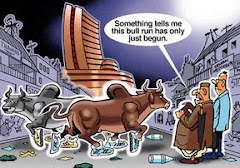
New US home sales for June came in at an annualized rate of 384,000, which is well above the 352,000 that were widely expected. The latest figures mark the highest sales rate since November, which totaled 390,00. The previous month's data was revised modestly higher to 346,000.
Though the latest rate of new home sales show higher demand for housing, the higher rate of new home sales can complicate the movement of existing home sales and keep inventory up. That could prolong the overall recovery process for US housing.
Monday, July 27, 2009
Sunday, July 26, 2009
Indices may revisit June highs soon...
Courtesy business-standard.com...
Better-than-expected first quarter numbers, steady foreign institutional inflows coupled with positive global cues helped the Indian stock markets post smart gains for the second consecutive week. The Sensex, which gained over 1,200 points in the preceding week, ended the week with a gain of over 600 points.
The Sensex began the week with a bang, up 446 points on Monday. The index, thereafter, consolidated and finally ended with a gain of 634 points at 15,379. In the process, the index moved in a range of 632 points, hit a high of 15,419 and a low of 14,787.
Among the index stocks, DLF and Tata Motors zoomed over 18 per cent to Rs 333 and Rs 316, respectively. Maruti, Jaiprakash Associates, Tata Steel, Hindalco, TCS and Sterlite gained 11-16 per cent.
The Sensex is now well-poised to target its June high of 15,600. Above which, the index may spurt to 15,825, and further up to 16,800 in the next few weeks. On the downside, the index is likely to find support around 15,135-14,990 levels, a break below which could see the index slide to 14,500.
The NSE Nifty moved in a range of 201 points, from a low of 4,378, the index rallied to a high of 4,579, and finally settled with a gain of 194 points at 4,569. The index is moving towards its June high of 4,693 too, above which it may rise to 4,950. On the downside, the index may find support at 4,490-4,445.
The Nifty is currently moving above its all three averages — short-term, mid-term and long-term. However, the mid-term (45 days) average is currently above the short-term (15 days) daily moving average, which at times signifies consolidation or range-bound movement.

S. Korea Economy Snaps Out of Stupor
South Korea's economy roared back to life in the second quarter, its best quarterly performance in more than five years, raising hopes the recovery is sustainable.
Saturday, July 25, 2009
US Market Update
US Markets Weekly Recap - Week ending 24-Jul-09
The US stock markets logged another impressive week as investors cheered better-than-expected earnings reports, with the S&P 500 surging 4.1%, marking an 11% gain since July 10.
The best performing sectors were materials (+8.1%), energy (+5.6%) and utilities (+5.6%).
The week got off to a positive bias on report from The Wall Street Journal that CIT Group (CIT) had reached an agreement with its bondholders to secure $3 billion in rescue financing, which was later confirmed by the struggling lender. Whether CIT will be able to avoid bankruptcy remains to be seen, although this will give the lender some time to explore its options.
With only a handful of economic releases, the main focus this week was the large amount of earnings reports -- 142 S&P 500 companies reported their quarterly results, including 12 Dow components.
Earnings for the most recent quarter largely came out ahead of expectations, with 111 beats, 10 in-line and 21 misses. But the earnings beats were largely due to cost cutting measures, not upside surprises on the top line. Specifically, 72 companies posted revenue that failed to live up to expectations, and 102 reported year-over-year declines in revenue.
For instance, Microsoft met analyst EPS estimates in its fiscal fourth quarter at $0.36, but the software giant's revenue decline of 17% y/y to $13.1 bln was well short of the $14.4 bln consensus. Shares of MSFT fell 4.0% for the week.
US Markets...
Tech stocks were under pressure for the entire session yesterday and caused the Nasdaq to log its first loss in more than two weeks, but a supportive bid in the broader market emerged to help the Dow and S&P 500 reverse early losses and finish with a modest gains.
Thursday, July 23, 2009
News...
Japan's export fall less severe as recession eases
Japan's exports in June fell by the smallest margin in six months, adding to evidence that global demand is recovering as the recession loosens its grip.
Other news...
# Porsche CEO steps down, making way for VW merger
# Credit Suisse reports 29 percent rise in 2Q profit
# Hyundai Motor Q2 net profit rises 48 percent
# Roche says half-year profit down 29 percent
Sunday, July 19, 2009
Market trends...
US Earnings Uptick Lifts American (And World) Investor Confidence
The first wave of US quarterly corporate earnings reports arrived stronger than expected, soothing investor fears of another economic crisis and helping push the Dow Jones Industrial Average to its strongest weekly gain since March.
The Dow ended the week up 7.3% at 8743.94, taking just five days to recover almost all the 7.4% decline of the previous four weeks, as investors took heart from blowout earnings by Goldman Sachs Group Inc. and positive comments from J.P. Morgan Chase & Co. and Intel Corp.
Sensex Ends up 3.5%; Gains Over 9% In The Immediate Past Week
Positive trade in global markets and heavy institutional buying - mainly by foreign investors - pushed Indian shares higher on Friday, enabling the Sensex to end the week with a 9.2% gain.
Monday, July 13, 2009
Goldman Sachs upgrade gives world markets a boost
European and U.S. stock markets rose today after a well-respected banking analyst stoked hopes that this week's earnings from some of the U.S.'s leading banks may well surprise to the upside.
The FTSE 100 index of leading British shares was up 65.36 points, or 1.6 percent, at 4,192.53 while Germany's DAX jumped 102.12 points, or 2.2 percent, to 4,678.43. The CAC-40 in France was up 37.23 points, or 1.3 percent, to 3,020.33.
And on Wall Street, the Dow Jones industrial average was up 48.44 points, or 0.6 percent, at 8,194.96 soon after the open while the broader Standard & Poor's 500 index rose 5.33 points, or 0.6 percent, at 884.46.
Europe had been trading only modestly higher while Wall Street futures had been pointing to a lower opening. That changed after Meredith Whitney told CNBC Television that she had upgraded her recommendation on U.S. investment bank Goldman Sachs Group Inc. to "buy" and raised her price target to $186 a share -- a day before it reports its second-quarter earnings. Whitney, who has been viewed as bearish on the sector, also said Bank of America Corp. could be good value.
In early trading, Goldman Sachs was up 2.9 percent at $145.98 while Bank of America rose 3.9 percent to $12.34.
The comments came as investors were fully focused on the U.S. second quarter reporting season, which really kicks into gear this week with a raft of companies reporting.
Whitney's upgrade "has given markets a shot in the arm," said Richard Hunter, equities strategist at Hargreaves Lansdown stockbrokers in London.
Most of the attention this will be on the U.S. banks, which arguably were the catalyst to the first synchronized global economic downturn since the Second World War. Goldman Sachs is the first major U.S. financial institution to report on Tuesday, followed by JPMorgan Chase & Co., Bank of American Corp. and Citigroup Inc. later in the week.
Saturday, July 11, 2009
US Stocks Mixed With Shaw Group Slipping, Yahoo Gaining
US Stocks finished mixed on Friday as profit reports trickled in, with Shaw Group sliding after an earnings miss, Yahoo gaining on an analyst upgrade, and Exxon Mobil continuing its recent decline.
The Dow Jones Industrial Average fell 36.65, or 0.45%, to 8146.52. For the week, the index lost 1.62%, declining for the fourth week in a row. The Standard & Poor's 500 lost 3.55, or 0.40%, to 879.13. For the week, the index lost 1.93%, also down four weeks in a row. The Nasdaq gained 3.48, or 0.20%, to 1756.03. For the week, it lost 2.25%, falling for the second straight week.
Friday's economic data showed that consumer confidence dropped in the middle of July.
"No one expects the second-quarter [earnings] to be good," said Marc Pado, U.S. market strategist at Cantor Fitzgerald. Earnings reports so far show that companies are still using cost cuts to prop up their profits and are yet to see sales rebound, he said.
Commodity stocks came under pressure during the week and extended some of those losses Friday. Crude stocks tumbled Friday as crude-oil prices continued to slide. Exxon fell 85 cents, or 1.3%, to 65.12, and lost 4.9% for the week.
Shaw Group fell 2.47, or 9.4%, to 23.69. The engineering and construction company's fiscal third-quarter earnings dropped, partly due to costs related to two fossil contracts.
Investors' focus turned to earnings this week as Alcoa reported results, marking the official start of the earnings season. The aluminum company reported a quarterly loss midweek but topped Wall Street's expectations. Its stock fell 5.3% for the week.
Elsewhere, CME Group fell during the week following news the U.S. Commodity Futures Trading Commission is planning to propose sweeping trading limits on oil, natural gas and possibly other commodities. For the week, the stock lost 12.7%.
Yahoo (Nasdaq) gained 38 cents, or 2.6%, to 14.93. Thomas Weisel upgraded Yahoo to market weight from underweight, saying it believes the company's outlook "is determined more by the operational changes made within the management ranks and less on a potential exogenous event with Microsoft."
American depositary shares of Infosys Technologies (Nasdaq) gained 1.46, or 4.2%, to 35.95. The Indian technology company Friday met some market expectations and beat some other market expectations and posted a rise in its fiscal first-quarter profit.
Friday, July 10, 2009
Infosys shines, Sensex whines
The Sensex today opened 105 points higher at 13,803 on the back of smart gains after Infosys came out with its Q1 numbers which were largely in line with the market expectations.
The index hovered around the break-even point for the major part of the day. The better-than-expected index of industrial production (IIP) numbers which rose to 2.7% in May lifted the sentiment for a brief while. As a result the Sensex spurted to a high of 13,897.
However, sudden selling in the late trades mainly in index heavyweight Reliance saw the index nose-dive to a low of 13,418, down 478 points from the day's high.
The Sensex finally ended at 13,504, down 253 points.
The BSE Oil & Gas index tumbled 3% to 8,533. The Power, Capital Goods, Realty and PSU indexes declined 2-2.5% each. While IT index advanced 2% to 3,196.
Reliance and HDFC accounted for nearlt half of the losses.While the former accounted for 80 points loss on the Sensex, the latter shaved off another 38 points.
The market breadth was fairly negative - out of 2,638 shares traded, 1,785 declined and 772 shares advanced on the BSE.
INDEX SHAKERS...
Reliance Infrastructure tumbled 6.5% to Rs 1,029, and Jaiprakash Associates slumped over 5.5% to Rs 186.
Sun Pharma slipped over 4% to Rs 1,121.
Reliance Communications dropped 5.5% to Rs 242, and Bharti Airtel was down 2% at Rs 782.
Reliance shed 4% at Rs 1,778. The stock clocked volumes of 1.12 million shares on the BSE today.
SBI declined 3.5% to Rs 1,544 and HDFC Bank decreased 2% to Rs 1,369. ICICI Bank was down 1% at Rs 629.
...AND THE MOVERS
Wipro advanced around 3.5% to Rs 384. Infosys added around 3% to Rs 1,726 after the company posted a 17.2% increase in net profit to Rs 1,527 crore for the first quarter of current fiscal as compared to Rs 1,302 crore for the quarter ended June 30, 2008. TCS gained 1.5% at Rs 394.
Sterlite moved up 3% to Rs 575.
VOLUME & VALUE TOPPERS
Educomp Solutions topped the value chart on the BSE with a turnover of Rs 266.77 crore. It was followed by Reliance (Rs 205.89 crore), Reliance Capital (Rs 201.77 crore), Suzlon (Rs 183.69 crore) and Unitech (Rs 165.10 crore).
Unitech led the volume chart with trades of 23.27 million shares. It was followed by Cals Refineries (22.73 million), Suzlon (21.08 million), Mahindra Satyam (20.03 million) and Reliance Natural Resources (10.11 million) shares on the BSE.
Saturday, July 4, 2009
MOUNTAIN OF DEBT: Rising US government debt may be next (world) crisis
MOUNTAIN OF DEBT: Legacy of debt from Founding Fathers not celebrated on Independence Day
The Founding Fathers of the United States of America left one legacy not celebrated on Independence Day but which affects us all (in the US and all over the world). It's the national debt.
The country first got into debt to help pay for the Revolutionary War. Growing ever since, the debt stands today at a staggering $11.4 trillion -- equivalent to about $37,000 for each and every American. And it's expanding by over $1 trillion a year.
The mountain of debt easily could become the next full-fledged economic crisis without firm action from Washington, economists of all stripes warn.
"Unless we demonstrate a strong commitment to fiscal sustainability in the longer term, we will have neither financial stability nor healthy economic growth," Federal Reserve Chairman Ben Bernanke recently told Congress.
Higher taxes, or reduced federal benefits and services -- or a combination of both -- may be the inevitable consequences.
The debt is complicating efforts by President Barack Obama and Congress to cope with the worst recession in decades as stimulus and bailout spending combine with lower tax revenues to widen the gap.
Interest payments on the debt alone cost $452 billion last year -- the largest federal spending category after Medicare-Medicaid, Social Security and defense. It's quickly crowding out all other government spending. And the Treasury is finding it harder to find new lenders.
The United States went into the red the first time in 1790 when it assumed $75 million in the war debts of the Continental Congress.
Alexander Hamilton, the first treasury secretary, said, "A national debt, if not excessive, will be to us a national blessing."
Some blessing.
Since then, the nation has only been free of debt once, in 1834-1835.
The national debt has expanded during times of war and usually contracted in times of peace, while staying on a generally upward trajectory. Over the past several decades, it has climbed sharply -- except for a respite from 1998 to 2000, when there were annual budget surpluses, reflecting in large part what turned out to be an overheated economy.
The debt soared with the wars in Iraq and Afghanistan and economic stimulus spending under President George W. Bush and now Obama.
The odometer-style "debt clock" near Times Square -- put in place in 1989 when the debt was a mere $2.7 trillion -- ran out of numbers and had to be shut down when the debt surged past $10 trillion in 2008.
The clock has since been refurbished so higher numbers fit. There are several debt clocks on Web sites maintained by public interest groups that let you watch hundreds, thousands, millions zip by in a matter of seconds.
The debt gap is "something that keeps me awake at night," Obama says.
He pledged to cut the budget "deficit" roughly in half by the end of his first term. But "deficit" just means the difference between government receipts and spending in a single budget year.
This year's deficit is now estimated at about $1.85 trillion.
Deficits don't reflect holdover indebtedness from previous years. Some spending items -- such as emergency appropriations bills and receipts in the Social Security program -- aren't included, either, although they are part of the national debt.
The national debt is a broader, and more telling, way to look at the government's balance sheets than glancing at deficits.
According to the Treasury Department, which updates the number "to the penny" every few days, the national debt was $11,518,472,742,288 on Wednesday.
The overall debt is now slightly over 80 percent of the annual output of the entire U.S. economy, as measured by the gross domestic product.
By historical standards, it's not proportionately as high as during World War II, when it briefly rose to 120 percent of GDP. But it's still a huge liability.
Also, the United States is not the only nation struggling under a huge national debt. Among major countries, Japan, Italy, India, France, Germany and Canada have comparable debts as percentages of their GDPs.
The Peter G. Peterson Foundation, established by a former US commerce secretary and investment banker, argues that the $11.4 trillion debt figures does not take into account roughly $45 trillion in unlisted liabilities and unfunded retirement and health care commitments.
That would put the nation's full obligations at $56 trillion, or roughly $184,000 per American, according to this calculation.
Friday, June 19, 2009
US, European, Asian (including Indian) Stocks Push Higher After Lackluster Week
US investors are shedding some of their caution about the economy. US stocks are rising today, following gains in markets overseas - in Europe and Asia - and a round of buying on Thursday (yesterday). Better than expected economic data is suggesting that the U.S. economy might be in better shape than some investors had feared.
Thursday, June 18, 2009
Asia stocks fall for 4th day; European shares down
Asian markets slide for 4th day as correction starts to take hold; European stocks falter
Asian stocks suffered their fourth straight day of losses Thursday amid a growing belief the markets were due for a reality check after the recent surge. European markets weakened in early trade.
Benchmarks in Tokyo, Hong Kong and elsewhere sputtered over 1 percent apiece in broad-based selling. Oil prices fluctuated around $71 a barrel while the dollar lost more ground against the yen.
Investors have become skeptical recently about the staying power of a massive spring rally amid signs that global industrial production and demand, while stabilizing, may still be far from lifting the economy out of its worst recession in decades.
Overnight weakness on Wall Street, as well as the urge to take some profits after months of gains as the second quarter closes out, only encouraged traders to sell more.
"It's time for the market to have a pause and for people to take stock of reality," said Song Seng Wun, economist at CIMB-GK in Singapore. "Nothing can go in a straight line unless the economy improves in the same straight line, and that's not happening."
Early in European trade, benchmarks in Britain, Germany and France were down by about 0.3 percent each.
Stock futures suggested slight gains Thursday on Wall Street. Dow futures rose 2 points to 8,495 and S&P futures gained 0.5, or 0.1 percent, to 905.80.
Japan's benchmark Nikkei 225 stock average fell 137.13 points, or 1.4 percent, to 9,703.72, and Hong Kong's Hang Seng dropped 307.94, or 1.7 percent, to 17,776.66.
South Korea's Kospi lost 1.1 percent, Australia's key index was down 0.3 percent and Taiwan's benchmark pulled back 0.8 percent.
But Shanghai shares defied the losses, with the benchmark climbing 1.6 percent to a 10-month high, as the World Bank raised its China 2009 economic growth forecast from 6.5 percent to 7.2 percent and the country's premier said the economy was showing "positive changes."
The World Bank said Beijing's stimulus-driven investment boom would help shield the world's third-largest economy from the downturn, but cautioned it was too soon to say a sustained recovery was on the way.
China's ability to prosper as overseas economies slump has been a popular theme among investors, helping drive mainland and Hong Kong shares -- as well as certain commodities -- to huge gains in recent months.
But there are tentative signs that optimism about Chinese growth may be peaking, and that the recent outperformance by emerging market shares may be winding down, according to a Merrill Lynch survey of investment fund managers released Thursday.
Still, the survey reflected a recent shift in confidence, suggesting investment fund managers as a group are more bullish on stocks than at anytime since the crisis began to unfold in December 2007.
In the U.S. Wednesday, Wall Street endured another lackluster session. A cautious forecast from FedEx Corp. and a ratings downgrade of 18 banks were cause for more handwringing among investors.
The Dow Jones industrial average fell 7.49, or 0.1 percent, to 8,497.18 after moving in and out of positive territory during the day. The broader S&P 500 index fell 1.26, or 0.1 percent, to 910.71.
Oil prices lingered near $71 a barrel Thursday in Asia, with benchmark crude for July delivery up 34 cents to $71.37 a barrel. The contract rose 56 cents overnight.
The dollar was lower at 95.65 yen from 95.87 yen. The euro declined to $1.3912 from $1.3970.
Wednesday, June 17, 2009
Asian markets lower as global rally loses steam
Asian markets mostly lower as global rally continues to lose steam; Hong Kong falls over 1 pct
Most Asian stock markets extended their losses Wednesday as the global rally continued to lose steam amid concerns about the pace of any economic recovery.
More signs of economic weakness in the U.S. inspired caution among investors, and softer prices for crude oil and metals in recent days pulled commodity stocks lower.
With some indexes up more than 50 percent since March on expectations of an economic turnaround this year, markets have begun to falter amid worries stock prices have gotten too far ahead of economic fundamentals.
News that American industrial production fell by a bigger-than-expected 1.1 percent last month gave investors in Asia, as in the U.S. overnight, even more reason to hold back. It was the seventh straight monthly drop in industrial production and distracted traders from more upbeat figures on home construction, building permits and inflation.
"The market is losing a little bit of momentum after the rally," said Winson Fong, managing director at SG Asset Management in Hong Kong, which oversees about $2 billion in equities in Asia. "Some sort of the healthy correction is expected in the near term. But I think the economic fundamentals will catch up."
Hong Kong's Hang Seng index lost 239.78, or 1.3 percent, to 17,925.72, and South Korea's Kospi shed 0.8 percent to 1,388.15.
Australia's benchmark fell 1.4 percent, India's Sensex dropped 0.8 percent and Shanghai's stock measure was off 0.7 percent.
Japan bucked the downward trend with the Nikkei 225 stock index gaining 58.06, or 0.6 percent, to 9,810.94.
Overnight, the Dow Jones industrial average fell 107.46, or 1.3 percent, to 8,504.67. The Standard & Poor's 500 index fell 11.75, or 1.3 percent, to 911.97, while the Nasdaq composite index fell 20.20, or 1.1 percent, to 1,796.18.
U.S. stock futures pointed to modest gains Wednesday on Wall Street. Dow futures rose 8 points, or 0.1 percent, to 8,522 and S&P futures gained 2.1, or 0.2 percent, to 909.90.
Oil prices hovered above $70 a barrel Wednesday in Asia, with benchmark crude for July delivery up 35 cents to $70.82. On Tuesday, the contract fell 15 cents.
In currencies, the dollar was higher at 96.61 yen from 96.17 yen. The euro rose to $1.3861 from $1.3813.
Monday, June 15, 2009
News updates...
Obama Financial Reforms Revealed - Reuters
Senior Obama administration officials today said in a newspaper editorial piece that a landmark financial regulation reform plan to be released this week will target capital requirements, securitization and other problem areas blamed for the global financial crisis.
Other News:
# IMF says worst not over for world economy - Reuters
# Oil falls to near $71 as US dollar strengthens - AP
# World stocks down as dollar rise hits commodities - AP
# US Stocks point lower as overseas markets fall - AP
# Obama urges doctors to back his health care plans - AP
# EU: 1.9 million jobs disappeared in Q1 - AP
# Lincoln National to accept US government funds - AP
# US Gas prices up 17 cents in 2 weeks - survey- CNNMoney
# Rain matches aviation gloom at Paris Air Show - AP
Friday, June 12, 2009
IIP nos fail to boost Sensex; Ranbaxy, DLF slip
The Sensex today opened 36 points higher at 15,447 and soon touched the day's high of 15,600. However, around noon it dipped sharply into the negative zone as the April IIP numbers failed to boost investor's sentiments. The index thereafter was volatile and touched a low of 15,174, down 426 points from the day's high.
The index finally ended at 15,238, down 173 points.
The BSE Metal and Oil & Gas indices, however, gained over 1% each to 12,220 and 10,510, respectively.
The market breadth was extremely negative - out of 2,774 stocks traded, 2,020 declined while 706 advanced. The rest were unchanged.
INDEX SHAKERS...
Ranbaxy and DLF plunged 6% each to Rs 282 and Rs 369, respectively.
Reliance Communications dropped 4.5% to Rs 332. Tata Motors, Mahindra & Mahindra and SBI slumped 3.5% each to Rs 357, Rs 786 and Rs 1,637, respectively.
Wipro, Bharti Airtel, HDFC, Larsen & toubro, BHEL, ACC, Grasim, NTPC were down 2-3% each.
Hindustan Unilever, Sun Pharma, Tata Power, TCS, HDFC Bank, Infosys, ICICI Bank, Reliance Infrastructure and Hindalco declined 1% each.
...AND MOVERS
Reliance gained 2.5% at Rs 2,357. Sterlite added 2% to Rs 718.
OTHER PROMINENT LOSERS...
Fortis Healthcare and Rei Agro slumped 8% each to Rs 105 and Rs 73, respectively. Lanco Infratech declined 7.5% to Rs 374.
Hindustan Construction Company, Max India, Andhra Bank, Tech Mahindra, Tulip Telecom, Aditya Birla Nuvo and GVK Power & Infrastructure dropped 6-7% each.
...AND OTHER GAINERS
JSW Steel soared 11% to Rs 707. Hindustan Zinc surged 8% to Rs 665. Sesa Goa rallied 5.5% after aquiring Dempo Group's Goa Mining Assets.
Jindal Steel, Cipla, Sintex Industries, Welspun Gujarat Stahl-Rohren, Union Bank and Cadila Healthcare added 3-5% each.
VALUE & VOLUME TOPPERS
Sesa Goa topped the value chart with a total turnover of Rs 462.03 crore. It was followed by Reliance (Rs 266.74 crore), Reliance Capital (Rs 229.93 crore), Tata Steel (Rs 223.81 crore) and Suzlon (Rs 217.79 crore).
The volume chart was led by Unitech with trades of 22.71 million, followed by Sesa Goa (22.26 million), Ispat Industries (20.24 million), Suzlon (17.68 million) and IFCI (13.75 million).
Saturday, June 6, 2009
Sensex has longest winning streak since August 2005
India’s stocks rose for a second day, on Friday June 5th, driving the benchmark index to its 13th weekly advance, as metal producers gained after copper and aluminum prices jumped.
Sterlite Industries, the nation’s biggest copper and zinc producer, added 2.1 per cent, while Hindalco Industries, the largest aluminum maker, climbed 3.5 per cent.
The benchmark index completed the longest weekly winning streak since August 2005 after the Congress party had its biggest election win in two decades. President Pratibha Devisingh Patil said yesterday the government might allow greater overseas investment and inject capital into lenders to stoke economic growth. Fund inflows surged to a one-year high.
“Those who missed the recent rally are chasing the stocks,” said A N Sridhar at Sahara Asset Management in Mumbai. “Markets are fairly valued at the moment, but high liquidity and budget expectations are driving the stocks up,” he said.
The Bombay Stock Exchange’s Sensitive Index, or Sensex, climbed 94.87 points, or 0.6 per cent, to close at 15,103.55. The S&P CNX Nifty Index on the National Stock Exchange added 0.3 per cent to 4,586.90. The BSE 200 Index increased 0.4 per cent to 1,848.04.
The Sensex has advanced 3.3 per cent this week. Indian funds attracted $199 million of inflows in the week ended June 3, a 55-week high, Cambridge, Massachusetts-based research company EPFR Global said in a report dated yesterday.
The Sensex has gained 57 per cent this year, the third-best performer among 90 benchmark indices tracked by Bloomberg worldwide. The index has soared 85 per cent since this year’s low on March 9, on speculation government stimulus spending worldwide will help to end the first global recession since World War II. Shares on the Sensex are valued at 16.1 times their reported earnings, almost double the 8.8 times they fetched in March.
Indian stock valuations may keep “bubbling higher” after a record gain earlier this week as the nation’s election results brightened the outlook for investor sentiment, liquidity and economic growth, UBS AG said on May 20.
Sterlite added 2.1 per cent to Rs 672.35. Hindalco climbed 3.5 per cent to Rs 92.9. National Aluminium Co, India’s second-biggest producer of the metal used to make aircraft and beverage cans, rose 1.3 per cent to Rs 348.20 after it said first-quarter profit will increase from the previous three months, aided by higher production and prices.
Copper and aluminum futures advanced in Shanghai on investors’ optimism that the global recession is easing, while the risk of inflation may be rising. Copper headed for a third weekly gain and aluminum jumped to the highest since November 20.
Larsen & Toubro jumped 4.6 per cent to Rs 1,522.60. India’s biggest engineering company plans to sell its 11.4 per cent stake in Ultratech Cement, according to reports.
Grasim Industries, India’s third-biggest cement producer and a maker of viscose-staple fiber, rose 5.7 per cent to Rs 2,513.35. Grasim holds 50.7 per cent in Ultratech, according to data compiled by Bloomberg.
Friday, June 5, 2009
Despite fewer cuts, US May jobless rate seen rising...
With companies in the US in no mood to hire, the unemployment rate is still rising. But the furious pace of layoffs is easing as the recession loosens its hold on the country.
Wednesday, June 3, 2009
Sensex ends flat amid choppy trade

The Sensex today opened 28 points higher at 14,903, following the positive global cues.
The index touched a nine-month high of 15,046 - up 313 points from the day's low.
Following the subdued opening in the European markets, the Sensex pared its gains and slipped into the negative zone. It touched a low of 14,733 on profit booking in IT and banking stocks.
The BSE IT and Bankex indices were down 1% each at 3,090 and 8,058, respectively.
However, trading was extremely choppy as investors continued with their alternative bouts of buying and selling in the market.
The Sensex snapped the six-day winning streak and finally ended at 14,871, down four points.
The market breadth was positive - out of 2,858 shares traded, 2,016 advanced, 792 declined and 50 were unchanged today.
INDEX MOVERS...
Hindalco and ITC added 6% to Rs 93 and Rs 203, respectively.
Jaiprakash Associates, Grasim and ACC soared 4.5% each to Rs 226, Rs 2,306 and Rs 818, respectively.
Reliance Communications and Tata Motors gained 4% each at Rs 333 and Rs 362, respectively.
Tata Steel, Hindustan Unilever, Sun Pharma, Sterlite and Ranbaxy were up 1-3% each.
...AND THE SHAKERS
Mahindra & Mahindra slumped 4% to Rs 698. Infosys and SBI dropped 2% each to Rs 1,646 and Rs 1,873, respectively.
ICICI Bank, HDFC Bank, Reliance and Reliance Infrastructures were down 1-2% each.
OTHER PROMINENT GAINERS...
Tech Mahindra zoomed 18% to Rs 658. Welspun-Gujarat Stahl Rohren, Aban Offshore, Suzlon Energy, Biacon, Zee Entertainment, Sun TV Network, Glenmark Pharma, Tata Tea, KSK Energy Ventures, Essar oil and United Phosphorus advanced 8-16% each.
...AND THE LOSERS
Jain Irrigation Systems slumped 6% to Rs 630. Rashtriya Chemicals and Fertilizers, NMDC, Mundra Port, Godrej Industries, Indiabulls Real Estate, CESC, Educomp Solutions, Indian Hotels Company, GTL Infrastructures, Indian Bank, Bank of Baroda, Andhra Bank, Cairn India, Pantaloon Retail India, Central Bank and Allahabad Bank declined 3-5% each.
VALUE & VOLUME TOPPERS
Suzlon Energy topped the value chart with a turnover of Rs 392.45 crore followed by Satyam (320.47 crore), Unitech (Rs 291.35 crore), Essar Oil (273.62 crore) and Tata Steel (Rs 264.72 crore).
Satyam Computer led the volume chart with trades of 48 million shares. It was followed by Cals Refineries (42 million), Ispat (38.75 million), Alok Industries (35.54 million) and Suzlon Energy (32.75 million
Sunday, May 31, 2009
Worst seems to be over for India Inc: Ficci survey
India Inc has regained the much-needed business confidence with majority of 300 companies stating, in an industry survey, that they see better economic outlook in the next six months.
As many as 57 per cent of the companies measured on the quarterly business confidence index (BCI) of Ficci, indicated that they expect the overall economic condition to be 'moderately to substantially' better in the next six months.
The Ficci survey of the fourth quarter of fiscal 2008-09 is in sharp contrast with findings of the BCI of the previous quarter when only 9 per cent firms had seen a bright outlook.
"The economy has bottomed out as was also indicated in the last survey and is clearly in the recovery mode," Ficci said.
The gross domestic production (GDP) recorded in the last fiscal was 6.7 per cent, which was better-than-expected.
Improvement in business confidence comes amidst the new UPA government working on a 100-day programme for putting the economy back on the fast track.
The BCI for the fourth quarter of fiscal 2008-09 was up to 64.1 from 44 in the last quarter.
About 47 per cent of the respondents said that their current firm performance has improved vis-à-vis last six months, representing a jump of 26 per cent from 21 per cent in the last survey.
The percentage of companies which saw a deterioration in their performance over the last six months has declined significantly to 18 per cent from 55 per cent in the last survey, the Ficci-BCI survey said.
The chamber has surveyed companies in various sectors, including textiles, cement, steel, leather, chemicals and fertilisers, FMCG, banking and autos.
However, the companies feel that there are hindrances in their growth, including weak demand, high cost of credit, although the credit problem has come down in the current survey.
The steps taken by the RBI and the government over the past two quarters have been instrumental in giving a boost to demand but there is still scope for further announcements to bring the economy back in full swing, the survey said.
Further, the respondents indicated that they would want to see a decline in interest rate by about 3-4 per cent.
"There is an immediate need to bring down the interest rate in line with the decline in the repo rate," the survey said.
Wednesday, May 27, 2009
Survey: most economists see recession end in '09
More than 90 percent of economists predict the U.S. recession will end this year, although the recovery is likely to be bumpy.
Other news...
# World stocks continue to rally on US economy hopes
# US likely taking majority ownership of GM
# Chrysler heads to court for key bankruptcy hearing
# Oil rises to 6-month high above $63
Other news...
# World stocks continue to rally on US economy hopes
# US likely taking majority ownership of GM
# Chrysler heads to court for key bankruptcy hearing
# Oil rises to 6-month high above $63
Monday, May 25, 2009
European markets flat, Asia gains...
European stocks searched for direction today, closing little changed amid ongoing concerns about the sustainability of recent market gains. Asian shares rose, shrugging off reports of a nuclear test by North Korea.
Sunday, May 24, 2009
Record gains for Sensex in 17 years
Stock indices rose, with the Bombay Stock Exchange Sensitive Index, or the Sensex, posting its highest weekly gain in 17 years.
The markets started the week on a extraordinary note, with the Sensex hitting the upper circuit twice in the day on Monday, and finally trading was suspended for the days with just few seconds of trade.
Over the week, the benchmark index gained 14.08 per cent, which is the sharpest since the week ended March 27, 1992. It has also risen for 11 consecutive weeks for the first time since August 2005. During these 11 weeks the index has gained a whopping 66.80 per cent (5,561 points) since the week ended March 6, 2009.
Among the index stocks - Reliance Infrastructure and Reliance Communications zoomed 37% and 36%, respectively. Tata Steel, SBI, Larsen & Toubro, Tata Motors, DLF and ONGC surged 29-34% each.
Jaiprakash Associates, Mahindra & Mahindra, ICICI Bank, BHEL, HDFC Bank, NTPC, Tata Power and ACC were the other major gainers.
However, the tech stocks did not participate in the market rally. Infosys shed nearly 5% at Rs 1,519. TCS and Wipro declined around 2% each.
Most India funds outpace Sensex since March 9
Out of 150 India equity funds, 89 have outperformed Sensex.
International equity funds for India have seen an appreciation of almost 74 per cent in the total value of their assets between March 9 and now, according to data collected from Bloomberg.
The total assets of these funds increased from $15.86 billion on March 9 to $27.52 billion on May 21 — a rise of 74 per cent. In comparison, the benchmark BSE Sensitive Index posted a return of 68.33 per cent during the same period.
Out of 150 India funds, the 89 which have outperformed the benchmark indices show an average return of 81.55 per cent. The remaining 61 funds, who underperformed the market, gained 56.28 per cent during the same period, on an average. These funds are based in Luxembourg, Mauritius, South Korea, Japan, Britain and the USA.
As per Bloomberg, the Net Asset Values (NAVs) of all funds have appreciated over 30 per cent during the period. As many as 17 funds posted impressive returns of more than 90 per cent, 108 funds between 50-90 per cent and the remaining 25 funds between 30-50 per cent.
One of the oldest India funds, JPMorgan Indian Investment Trust, which is listed in the UK, showed a return of 60 per cent, while the NAVs of Jupiter, Neptune and New India Investment trust funds increased by around 50 per cent in the period.
They are mobilising resources from overseas investors to invest in equity markets of major countries.
The Indian-stock Exchange-Traded Funds (ETFs) enjoyed more gains as NYSE-listed funds joined in the buying spree during the recent market rally. PowerShares India Portfolio, Barclays iPath ETN and WisdomTree Investments Inc — which track a broad gauge of stocks listed on the Bombay Stock Exchange and the National Stock Exchange — have posted a return of more than 85 per cent.
Top holdings of these funds were Reliance Industries, Infosys Technologies, ICICI Bank, Housing Development Finance Corp and HDFC Bank.
Investing in India presents vast opportunities for global equity investors, especially when contrarian outlooks reveal beaten-down value funds. The funds' objective is long-term capital appreciation. They invest in large-cap Indian equity securities and A-plus rated instruments, giving 100 per cent exposure to the MSCI India Index. The funds also look at market timing to take advantage of the high volatility in the Indian markets and invest in companies whose activities are closely related to the economic development of India.
The India funds, which operate from the US, top the value-appreciation chart, with an average return of 93.86 per cent. The total assets of these funds increased from $973 million on March 9 to $1.89 billion. They were followed by Mauritius (79.57 per cent), Luxembourg (78.50 per cent), France (76.25 per cent), Singapore (70.72 per cent), Finland (68.90 per cent), UK (56.47 per cent) and South Korea (52.78 per cent).
The NAV of Luxembourg-listed HSBC GIF India equity fund has almost doubled between March 9 and May 21. The world's largest single holding of Indian equities outside the nation, this fund's total assets stood at $2.78 billion as on May 21.
Monday, May 18, 2009
SENSEX SECONDS PEOPLE'S VERDICT... ZOOMS 17%

Investor wealth swells by Rs 6.5 lakh cr in a minute
Investors have become richer by a whopping Rs 6.5 lakh crore in just a minute as the Sensex saw a historic 2,111 point rise to the 14,000 level as the markets cheered the decisive win of the ruling UPA government in the Lok Sabha elections.
Investor wealth, measured in terms of the combined market capitalisation of all the listed companies, increased by over Rs 6,56,477 crore in a minute -- in the first 30 seconds and then after the resumption of trading at 1155 hours -- to Rs 44,63,420.97 crore.
The 30-share Bombay Stock Exchange, the Sensex, zoomed 1,305.97 points at 13,479.39, hitting the upper circuit within seconds of opening of trade, following which trading was halted for two hours. After trading resumed, the Sensex soared 806 points at 14,284.21, following which trading was halted for the day.
Hopes of a stable government at the Centre for the next five-years, and positive moves such as stimulus and reforms taking place during this period have boosted the sentiment in the Indian stock markets.
Life in a way has come in full circle for the UPA. In 2004, when the UPA coalition came to power, the Sensex hit its 10% lower circuit and tanked over 11% eventually. Today, however, the index has done a complete vice versa, the index has hit its 20% upper limit and has closed for the day.
The change in fortunes is for obvious different reasons, last time around a coalition government backed by Left support was coming into power, while this around it's an almost majority UPA government coming to power.
Sensex creates history: hits 14,000, triggers trade halt

Welcoming UPA's win in the general elections, Indian markets opened on a very upbeat note triggering off circuit breakers for the first time ever.
The markets surged nearly 15 percent within seconds of opening on today, triggering circuit breakers that halted trade for two hours as investors celebrated a sweeping election victory for the ruling coalition.
The markets further extended their gains, immediately on re-opening after the two hour halt, which triggered the final circuit breaker that shut trade for the day.
It was the first time a circuit breaker has been set off by a rise in the Bombay Stock Exchange (BSE), a spokesman said.
The benchmark 30-share BSE index rose 17 percent to 14,284 points, its highest since September 23, and the 50-share National Stock Exchange (NSE) index jumped 15 percent to 4,203.30, also an eight-month high.
Earlier, the BSE said its index had risen 11 percent before the halt.
"It is very surprising because the turnover was not much. It's very hard to understand how the circuit breakers have been triggered when the volumes are so low," T.S. Harihar, vice president at ICICI Securities, said.
Circuit breakers are set based on moves of 10 percent, 15 percent and 20 percent using the close to the previous quarter as a base. Triggering a circuit breaker in one market also closes the other.
The BSE index was up 1,790 points and the NSE index was up 532 points at the halt, both having crossed the 15 percent trigger limits.
When trade resumed, the BSE index extended its rise to 2,110 points and the NSE rose to be up 600 points on the day. The 20 percent limit was triggered and trade was halted for the day.
Monday, May 11, 2009
World markets down as rally runs out of steam
World markets lower as some investors book profits from rally; Hong Kong off nearly 2 pct
Global stock markets retreated today, breaking several days of gains, as positive news of fewer job losses in the U.S. was blunted by investors moving to book recent profits.
Most Asian markets closed down, with white-hot Chinese and Hong Kong shares giving back all their gains from early in the session and then some. Crude oil prices and the dollar both slid.
The region's investors were emboldened early in the day by the latest dose of less dreary news: a key monthly job report showing the world's largest economy shed 539,000 jobs last month -- the lowest in six months. The reading amounted to far fewer than forecast, feeding a popular theme of economic recovery that's driven world markets sharply higher since early March.
But many analysts say recent improvements in the economy may not justify the swift rise in equity prices of late. They say the rally is being fueled in part by hot money flowing from mutual funds and other big investors that could delay a major correction for weeks or months but isn't the stuff of lasting bull runs.
"The markets are becoming overbought. The fundamentals of the economy just don't support these levels so we're seeing some profit taking," said Peter Lai, investment manager at DBS Vickers in Hong Kong.
European markets opened lower with Britain's FTSE 100 down 1.1 percent, Germany's DAX off 1.4 percent and France's CAC-40 losing 1.5 percent. Wall Street looked to give back some of its gains after U.S. futures fell. Dow futures were down 94 points, or 1.1 percent, to 8,422, while S&P 500 futures were down 12.7 points, or 1.4 percent, to 912.
In Asia, Japan recouped losses to closed higher, with the Nikkei up 19.15 points, or 0.2 percent, to 9,451.98, as hopes for a global economic recovery eclipsed disappointment over a stream of poor corporate earnings. Weighing on the broader market were automakers after Toyota reported its worst-ever annual loss -- and forecast an even bigger losses this year. Toyota shares fell 4.8 percent.
Chinese shares, meanwhile, snapped a six-session winning streak as the benchmark Shanghai Composite dropped 1.8 percent to 2,579.78. That dragged on Hong Kong's Hang Seng, off 301.92 points, or 1.7 percent, to 17,087.95 after climbing nearly 2 percent early in the day.
Investors in greater China were watching for a chance to take profits after the recent rally, though prices initially rose after the government reported that China's main inflation barometer fell 1.5 percent in April from a year earlier, in line with expectations.
The data, along with reports that bank lending may have fallen from record levels, dashed hopes for another interest rate cut, analysts said.
Elsewhere, South Korea's Kospi gained 0.2 percent and Taiwan's benchmark rose 1 percent; Australia and India stock measures fell.
In New York Friday, investors consoled by the government's bank tests and the jobs report sent the Dow up 164.80 points, or 2 percent, to 8,574.65. The Standard & Poor's 500 index rose 21.84, or 2.4 percent, to 929.23, and the Nasdaq composite index rose 22.76, or 1.3 percent, to 1,739.00.
Most Asia markets extend gains after US job data
Most Asia markets extend gains as US job data buoy confidence; Hong Kong up nearly 2 pct
Asian stocks were mostly higher today morning as news of fewer job losses in the U.S. gave investors more confidence the world's largest economy was headed toward recovery.
Gains across most of the region added to a two-month rally that's showing few signs of abating as expectations grow for an end to the global slump by year's end. Asian bank shares rose after their struggling U.S. peers advanced Friday amid relief over the government's "stress tests," while the dollar climbed against the yen. Oil prices, moderately lower, were still trading near this year's peak.
The latest dose of less dreary news came from a key monthly job report showing U.S. employers axed 539,000 jobs last month. It was the lowest in six months and far fewer than forecast, feeding a theme of recovery that has emboldened bullish investors of late.
While many analysts say recent improvements in the economy may not justify the swift rise in equity prices, hot money flowing from mutual funds and other big investors could put off any correction in the market for weeks or months.
"I wouldn't say things are getting better, but they are getting less worse. We are starting to see some stabilization," said Andrew Orchard, Asia strategist for Royal Bank of Scotland in Hong Kong. "The concerns long-term are we may overshoot and predict a recovery too quickly."
Hong Kong's Hang Seng climbed 289.20, or 1.7 percent, to 17,679.07, and South Korea's Kospi was 0.3 percent higher at 1,415.99.
Japan recouped losses to edge higher, with the Nikkei up 10.62 points, or 0.1 percent, at 9443.45. Weighing on the broader market were automakers after Toyota reported its worst-ever annual loss -- and forecast an even bigger losses this year. Toyota shares were down 4.8 percent.
Elsewhere, Taiwan and Indian benchmarks rose, while those in Shanghai and Australia were modestly lower.
In New York Friday, investors consoled by the government's bank tests and the jobs report sent the Dow up 164.80 points, or 2 percent, to 8,574.65. The Standard & Poor's 500 index rose 21.84, or 2.4 percent, to 929.23, and the Nasdaq composite index rose 22.76, or 1.3 percent, to 1,739.00.
Wall Street looked to give back some of its gains after U.S. futures fell. Dow futures were down 46 points, or 0.5 percent, to 8,470, while S&P futures were down 5.7 points, or 0.6 percent, to 919.
Friday, May 8, 2009
Inflation, election blues pull down markets...
The Sensex today opened in the red at 12,093, down 24 points. The index swung between zones till noon wherein it touched a high of 12,180. The index then broke down owing to rise in inflation rates and profit taking at higher levels. Uncertainity over the election results also weighed on the market sentiments.
The index touched a low of 11,765, down 415 points from the day's high.
The Sensex finally ended down 241 points at 11,876.
The market breadth was neutral. Out of 2,621 stocks traded, 1,267 declined while 1,266 advanced. The rest were unchanged.
INDEX SHAKERS...
Wipro slumped 7% to Rs 355. ICICI Bank, Sterlite and Reliance Infrastructure plunged 5% each to Rs 521, Rs 492 and Rs 769, respectively.
Mahindra & Mahindra , HDFC, Reliance Communications and Tata Steel shed 4% each at Rs 494, Rs 1,740, Rs 230 and Rs 283, respectively.
ACC, BHEL and SBI dropped over 3% each.
HDFC Bank, Hindalco, Infosys, DLF, Bharti Airtel, Tata Motors, Maruti Suzuki, NTPC, Tata Power, Reliance, ITC and ONGC declined 1-3% each.
...AND MOVERS
Jaiprakash Associates gained 2.5% at Rs 142. Hindustan Unilever advanced 1% to Rs 233.
OTHER PROMINENT LOSERS
United Spirits tumbled nearly 7% to Rs 667. Jain Irrigation Systems plunged 5.5% to Rs 490.
United Phosphorus, Glenmark Pharma, RECL, Godrej Industries, Ambuja Cement, Jindal Steel, Tulip Telecom, JSW Steel, Adani Enterprises, Zee Entertainment, IVRCL Infrastructure and Cadila Healthcare declined 4-5% each.
AND GAINERS
Bhushan Steel zoomed 14% to Rs 683. GMDC soared 10% to Rs 71. Neyveli Lignite Corporation surged 9% to Rs 103.
Hindustan Copper, Aban Offshore, Videocon Industries, Welspun Gujarat Stahl Rohren, GTL Infrastructure, UCO Bank, Jai Corp, Indiabulls and Shriram Transport Finance Company advanced 4-7% each.
MOST ACTIVE COUNTERS
HDFC Bank topped the value chart with a turnover of over Rs 1,524.22 crore. It was followed by Reliance (Rs 203.46 crore), ICICI Bank (Rs 186.57 crore), Tata Steel (Rs 177.99 crore), and HDIL (Rs 166.25 crore).
Ispat Industries led the volume chart with 30.79 million shares traded on the BSE. It was followed by Reliance Natural Resources (14.39 million), Suzlon (13.68 million), HDFC Bank (13.67million) and Unitech (11.54 million).
Wednesday, May 6, 2009
Rules for Investing in the Next Bull Market
Courtesy:

How to be smarter when the bull market comes back – and it will.
Is this a new bull market? Nobody really knows for certain. But one will -- presumably -- come along in due course. Will investors make the same mistakes they made last time, or will they be wiser? Here are 11 rules for the next bull market -- whenever it turns up.
1. Avoid big moves.
If you buy or sell heavily in one shot you're taking a needless risk. And waiting for the right moment to make your move is futile. You probably won't catch the bottom or the peak anyway. If a market trend has much further to run, then what's the rush? And if it doesn't … what's the rush?
2. Remember the market is just "us."
No wonder shares rose when everyone was buying, and fell when they were selling. That was the reason. And when everyone is trying to predict "the market," they are effectively chasing themselves through a hall of mirrors.
3. Don't get fooled, don't get tense… and don't get fooled by the wrong tense.
Wall Street is riddled with people who mistake the past perfect ("these shares have risen") with the present ("these shares are rising") or the future ("these shares will rise."). Don't get suckered.
4. Pay no attention to TINA.
Sooner or later someone will urge you to buy shares, even at very high prices, because There Is No Alternative. It is a popular hustle at the peak of the market. There are always alternatives -- like holding more cash until valuations are more attractive.
5. Be truly diversified.
That means investing across a spread of different asset classes and strategies. As investors discovered last year, "large cap value" and "mid cap blend" funds don't offer diversification. They're just marketing gimmicks.
6. Treat forecasts with a grain of salt.
Most economists missed the recession, most strategists missed the crash, and most analysts are bullish just before a stock falls. Even the good experts are prone to group think, office politics, career risk - and hall of mirror syndrome (see point 3, above).
7. Never invest in what you don't understand.
Be happy to underperform a bull market. During the last boom, many investors were advised to go all-in on shares to get the biggest long-term gains. But the stock market has infinite risk tolerance and an infinite time horizon. Real people can't compete with market indices, and shouldn't try.
8. Ignore what everyone else is doing.
It's natural to want to "join the crowd" and avoid being "left behind." Leave those instincts in eighth grade. When it comes to investing, do what's right for you and your family.
9. Be patient.
Investment opportunities are like buses. If you missed one, you don't have to chase it. Relax. If history is any guide, others will be along shortly.
10. Don't sit on the sidelines completely until it's too late.
You'll probably end up splurging at the last moment. If you are afraid to invest, do it early, little, and often.
11. And above all: Price matters.
After all, an investment is just a claim check on future cash flows, whether it be a company's profits, a bond's coupons or an annuity's income stream. By definition, shares in a solvent company are twice as good at half the price… and vice versa. It's amazing how many people get suckered into thinking it's the other way around.
Sunday, May 3, 2009
US Stocks Start Month With Modest Gain
US stock markets edged higher on Friday as investors assessed the previous month's surge and the economy's chances of recovery.
The Dow Jones Industrial Average climbed 44.29 points, or 0.5%, to 8212.42. For the week, the Dow industrials gained 1.7%.
The S&P 500 rose 4.71 points, or 0.5%, to 877.52 amid a 3.2% jump in its energy sector as oil prices put in a solid rally that helped to boost the shares of producers. The broad market measure was up 1.3% on the week.
Crude-oil futures rose $2.08 to settle at $53.20 a barrel, a six-week high.
As in the stock market, budding hopes for an economic recovery have pushed oil prices higher in recent weeks. Oil also seemed to benefit from a round of short covering, or unwinding of bearish bets, after it failed to break through overnight lows around the psychologically important $50 level, traders said.
"We've got a light-volume market in crude right now, and in that kind of environment, the short-term money can really move prices around," said Ray Carbone, president of Paramount Options, a floor brokerage in New York. "That's what we're seeing with a lot of this covering going on today." (Friday)
The Nasdaq Composite Index rose 1.90 points, or 0.1%, at 1719.20 on Friday. It rose 1.5% whole of last week.
Economic news...
Citi Said To Need Upto $10 Billion
Citigroup may need to raise as much as $10 billion in new capital, as the government continues negotiations with banks over the results of its so-called stress tests.
Chrysler's Bankruptcy Staggers Affiliates
Chrysler faced mounting pressure as the auto maker was forced to idle four plants and its dealers scrambled to find new sources of credit a day after the company filed for Chapter 11 bankruptcy protection.
ADB Plans $3 Billion Crisis Fund
The Asian Development Bank is planning to launch a $3 billion loan facility to help its "developing member countries cope with the crisis."
Thursday, April 30, 2009
News in brief - US
US stock futures rise ahead of economic data
World markets rally on Fed's US assessment
Dow Chemical 1Q profit drops 97 percent
Oil jumps above $51 on optimism recession slowing
Cigna 1Q profit more than triples
Procter & Gamble profit falls as consumers cut back
Crude rises despite large buildup in inventory
Motorola loss widens
Lewis out as Bank of America chairman, remains CEO
Monday, April 27, 2009
World Markets Struck by Swine Flu Fears
World stock markets fell today as investors worried that a deadly outbreak of swine flu in Mexico could go global and derail any global economic recovery.
Volatile Sensex ends marginally higher
The Sensex opened 92 points lower at 11,237, and touched a low of 11,177 owing to weak cues from the Asian markets. The index, however, soon recovered and rebounded into the positive zone backed by fresh buying in banking, capital goods and metal stocks.
The index moved up to a high of 11,492 - up 315 points from the day's high. Profit taking in noon trades saw the index slip back into red. The Sensex thereafter displayed zig-zag movement and finally ended with a gain of 43 points at 11,372.
The BSE Bankex rallied 2.4% to 5,727, and the Capital Goods index gained 1.6% at 8,072. However, the Realty index dropped 2.4% to 2,202.
The market breadth was negative. Out of 2,582 stocks traded,1,341 declined and 1,158 advanced.
Meanwhile elsewhere in Asia - the Hang Seng slumped 2.7% (418 points) to 14,840. The Taiwan Weighted index dropped 3% to 5,705. The Shanghai Composite and the Straits Times declined nearly 2% each.
INDEX MOVERS...
ICICI Bank surged 8% to Rs 468. Wipro and Sterlite advanced over 4% each to Rs 325 and Rs 415, respectively.
Jaiprakash Associates and TCS rallied over 3.5% each at Rs 130 and Rs 603, respectively.
Larsen & Toubro and Sun Pharma added over 2.5% each to Rs 908 and Rs 1,230, respectively.
...AND THE SHAKERS
Ranbaxy slipped over 4.5% to Rs 168.
Reliance infrastructure and Reliance Communications shed over 3.5% each to Rs 711 and Rs 223, respectively.
Hindustan Unilever, ACC and Tata Steel dropped 3% to Rs 231, Rs 659 and Rs 253, respectively.
VALUE TOPPERS
ICICI Bank has topped the value chart with a turnover of Rs 366.67crore followed by Reliance Capital (Rs 208.85 crore), Jaiprakash Associates (Rs 198.91 crore), Reliance (Rs 195.64 crore) and Indiabulls Realestate (Rs 175.95 crore).
Investment strategy henceforth...
Amid expectations of volatility and range bound markets, experts believe that this is the right time to build a good long-term portfolio. The ultimate advice to nail into one’s head is whether you make money.
Whether it is a bear market rally or bull market, it is an academic question. Assuming the Sensex rallies to 16,000 and then falls to 7,500 levels, this would have been a bear market rally, but one that produces a 100 per cent gain. What counts is to make money.
On how global markets are likely to move, the general opinion is that following the rally uptil end April we would have a correction. This would be followed by renewed strength until July and then weakness again, but the March 6 lows on the S&P 500 at 666 may hold.
Fot the next few months India should continue to trade up, but interrupted by corrections.
So, if the markets are to go up, then there is a lot to be made. Notably, the Indian market is the second best in terms of growth, next only to China, which provides comfort given that 11 of the 15 markets in the world are expected to report a decline in their GDP growth in CY2009.
On the flip side, an unfavourable outcome in domestic elections may prevent the markets from rising, if not fall, should global markets look up. In the context of the current situation, taking a call on investing may look all the more tricky. What is compelling now, says Gul Teckchandani, investment consultant, “You are getting the price advantage. But, buy with at least a one-year perspective.” He adds, “Apart from the basic checks (management, track record, earnings growth), one can buy stocks with PE with 3-4 in the B-group and 7-8 PE in A-group. Avoid businesses that you don’t understand and ones from export-oriented sectors (excluding IT) where there is a slowdown.”
Among the most common advice by experts, for investors who are already invested and aim to make use of the expected near-term volatility, is to book profits on sharp rallies and hold some cash in the portfolio to take the advantage of the expected volatility. Using the cash to invest on dips (particularly during elections) in a phased manner is also advised. Investors can look at the companies, which are relatively stable and are leaders in their respective segments. Stick to domestic-consumption led stories.
Regarding the sectors and themes that could reap good returns are FMCG, telecom and pharma besides, interest rates sensitive like banking and auto. Selectively investing in infrastructure-related companies (less leveraged and well-diversified) is seen as a good strategy, as irrespective of which party forms the government, infrastructure development will remain a focus area. However, the common advice ia to avoid cyclicals and real estate.
Sunday, April 26, 2009
On high octane
The stock market rally in India in the last seven weeks has been substantial and swift.
The 30-share BSE Sensex has risen by 33.5 per cent in just six weeks (from March 9 till April 21) and another 2.84 per cent over the next week, taking total gains to nearly 39 per cent over seven weeks. This performance is the second best among key global markets.
Interestingly, all the 15 popular global markets have reported gains, with eight of them up between 20 and 30 per cent during the six weeks.
Thus by far, the domestic market rally is driven by and reflects improved global sentiments.
In other words, it also suggests that even as India is economically dependent (by about 85 per cent) on domestic consumption in terms of GDP growth, its financial markets to a large extent are influenced by global sentiments. Additional proof: FIIs have invested $1.08 billion (since April 1) or $1.4 billion (since March 9) till April 21—domestic institutions have pumped in about Rs 750 crore – as compared to $1.65 billion of sales between January 1, 2009 and March 9. The case is not significantly different for others markets.
This change in global sentiment is led by positive news flow in the recent past including the new Geithner plan (in US), the G-20 meet (committing a $1 trillion boost), US President Barack Obama talking about things getting better, the stimulus packages and monetary measures undertaken earlier by various governments and central banks.
Thursday, April 23, 2009
Sensex ends up 317pts; Wipro, Tata Steel soar

The Sensex today opened up 24 points at 10,842. Soon the index slipped into the red and touched a low of 10,759.
The index, thereafter, rebounded into the positive zone and gained strength as the day progressed. Agressive buying towards the end saw the index soar to a high of 11,203 - up 444 points from the day's low.
The Sensex finally ended at 11,135, up 317 points from the previous close.
The market breadth was positive. Out of 2,599 stocks traded, 1,447 advanced and 1,049 declined.
INDEX MOVERS
Wipro soared 11% to Rs 313. Tata Steel surged 9% to Rs 263.
Grasim and Reliance Infrastructure gained 7% each at Rs 1,706 and Rs 713, respectively.
Maruti Suzuki, Sterlite and ICICI Bank rallied 6% each to Rs 800, Rs 390 and Rs 424, respectively.
Tata Motors gained over 5.5% at Rs 245. Infosys, DLF, Reliance Communications, Jaiprakash Associates, TCS, Larsen & Toubro, Mahindra & Mahindra and Hindalco advanced 4-5% each.
OTHER PROMINENT GAINERS...
Ashok Leyland and HDIL zoomed 12% each to Rs 23 and Rs 145, respectively. Indiabulls Realestate, Lanco Infrastructure, JSW Steel, Tech Mahindra, Educomp Solutions, SAIL, Adani Enterprises, Axis Bank, Max India, LIC Housing Finance and Petronet LNG surged 6-11% each.
...AND THE LOSERS
Bajaj Holdings and Investments crashed 10% to Rs 376. Zee Entertainment plunged 6% to Rs 119. Rolta India, Jai Corp, Yes Bank, Unitech and RCF fell 3-6% each.
MOST ACTIVE COUNTERS...
Reliance topped the value chart with a turnover of Rs 234.72 crore followed by Reliance Capitals (Rs 219.76 crore), HDIL (Rs 212.23 crore), Reliance Infrastructure (Rs 196.81 crore) and Tata Steel (Rs 179.54 crore).
Unitech led the volume charts with trades of over three crore shares followed by HDIL (1.55 crore), Suzlon (1.54 crore), Reliance Natural Resources (1.51 crore) and Ispat Industries (1.14 crore).
Wednesday, April 22, 2009
Sensex falls for third straight day on profit-selling...
The Bombay Stock Exchange benchmark Sensex failed to preserve early gains on today and closed with a loss of nearly 80 points, the third decline in a three day row.
The Sensex, which had recorded a gain 138 points at the outset, tumbled to end 80.57 points lower at 10,817.54. The key index touched the day's high 11,036.24 and a low of 10,715.66.
Similarly, the 50-share National Stock Exchange index Nifty fell 35.00 points at 3,330.30, after rising to 3,401.10 points and dipping to 3,296.90 points.
Seven in the Sensex pack, led by Reliance Industries and ACC, closed higher and averted any major fall. However, the other 23 ended with losses.
Marketmen said the surge in share prices of firms such as Bharti Airtel, Maruti Udyog and DLF Ltd in the past few sessions attracted profit selling by speculators at existing higher levels.
They said trading sentiment remained bearish with the general elections on and the opinion polls showing no clear winner.
ACC Ltd gained 5.26 per cent to Rs 645.75, after the biggest cement maker said first-quarter profit rose 13 per cent, better than market expectations.
Wipro Ltd, a major software exporter, surged to a six-month high by gaining 2.70 per cent to Rs 281.65 after the company announced four per cent rise in profit.
The market ended in negative territory as stocks in realty, consumer durables, capital goods, auto, banks, healthcare, power and the refinery segment recorded small to notable losses.
However, a rise in IT and fast-moving consumer goods stocks saved the market from any further fall.
The realty sector index fell 4.57 per cent to 2,146.49, consumer durables 4.05 per cent to 1,771.53, capital goods 2.94 per cent to 7,561.96, auto 1.91 per cent to 3,300.31, healthcare 1.49 per cent to 3,006.03, bank 0.76 per cent to 5,276.29, metals 1.20 per cent to 6,755.00 and oil & gas 0.62 per cent to 7,802.70.
With selling pressure spread widely, the smallcap index fell 1.57 per cent to 3,964.82 and the midcap index by 1.03 per cent to 3,486.93.
On the other hand, the FMCG index gained 0.48 per cent to 2,114.45 and the IT index by 0.26 per cent to 2,427.35.
Corporate results...
Wipro Net Profit Up 4%
Wipro posted a 4% rise in its financial fourth-quarter net profit and forecast a weaker three months ahead for its information technology services.
HCL Technologies Profit Drops
HCL Technologies, among India's top five software exporters by sales, said its consolidated third-quarter net profit fell 36% from a year earlier, dragged by foreign exchange and accounting losses.
ACC Profit Up 23%, Shares Jump
Shares of ACC jumped after it reported a better-than-expected 23% rise in its first-quarter consolidated net profit due to higher sales.
Morgan Stanley Posts Loss
Morgan Stanley swung to a first-quarter loss as results at almost all its business units worsened from a year earlier. The Wall Street giant also cut its quarterly dividend 81%.
Monday, April 20, 2009
Asian markets inch higher ahead of US earnings...
Asian stocks ended higher today as the Chinese premier's upbeat assessment of the world's third-largest economy soothed nerves ahead of key earnings reports from leading U.S. companies.
Thursday, April 16, 2009
Wall Street set for a mixed opening
Wall Street is poised for a mixed opening Thursday after news that JPMorgan Chase & Co.'s first-quarter profit topped analysts' estimates was tempered by word that the big mall operator General Growth Properties Inc. had filed for bankruptcy protection.
The better-than-expected earnings at JPMorgan are further evidence that the banking sector might be stabilizing, coming days after Wells Fargo & Co. and Goldman Sachs Group Inc. also reported profit above analysts' forecasts.
New York-based JPMorgan said its first-quarter profit fell to $2.1 billion, or 40 cents per share, from $2.4 billion, or 67 cents per share, a year ago. The results topped analysts' expectations for earnings of 32 cents per share.
While investors have been rallying in recent weeks on upbeat news out of the financial sector, the market got another dose of reality about where the economy stands as General Growth, the nation's second-largest mall operator, filed for Chapter 11 bankruptcy protection. The company said it was unable to persuade debtholders to give it more time to refinance its debt.
Dow Jones industrial average futures declined 34, or 0.43 percent, to 7,946. Standard & Poor's 500 index futures declined 4.3, or 0.51 percent, to 844.20, while Nasdaq 100 index futures rose 1.75, or 0.13 percent, to 1,318.75.
The market is trying to sustain momentum a day after the market moved higher amid a Federal Reserve report showing glimmers of hope in U.S. business conditions. The Dow gained 109 points.
Investors will get plenty of further earnings and economic data Thursday that should provide more insight into any potential economic recovery.
Earnings are due out for a wide range of companies, including newspaper publisher Gannett Co., paint and wall-covering company Sherwin-Williams Co. and Internet giant Google Inc.
Aside from a new round of earnings reports, two major economic reports will be released that will provide further insight into potential recovery in the economy. The Commerce Department reports about monthly housing starts, while the Labor Department will release weekly jobless claims data.
New jobless claims are expected rise to a seasonally adjusted 655,000 from the previous week's 654,000, according to economists surveyed by Thomson Reuters. Continuing claims are forecast to jump to 5.89 million from 5.84 million, which would be the highest number of claims on records dating back to 1967.
JPMorgan Chase posts better-than-expected profit
JPMorgan Chase says it earned $2.1 billion, thanks to rising deposits and lower borrowing rates. The profit was 13 percent lower than last year, but better than expected.
Sunday, April 12, 2009
Wkly Technical Analysis: Resistance seen around 11,000

Courtesy: Business Standard
The Sensex ended higher yet again with a gain of nearly 4.5 per cent at 10,804 in a highly volatile week. In the process, the index has now soared 30 per cent (2,478 points) in the last five trading weeks.
Among the index stocks, Jaiprakash Associates was the top gainer with a gain of almost 18 per cent. Tata Steel, Larsen & Toubro, Reliance Infrastructure, Tata Motors, ICICI Bank, DLF, Reliance Communications and HDFC gained in the range of 8-16 per cent.
The target for the current rally remains 12,600 which could be achieved in the next couple of months. In the coming week, the index is likely to face some resistance around the 11,000-mark, and further up at 11,200. The 11,000-mark is R3 (Resistance 3 or 0.62 per cent retracement of the February range) on the monthly charts, and 11,200 is R3 on the quarterly charts.
Since, the rally has been so sharp and the 14-day RSI (Relative Strength Index) continues to remain in the overbought zone, profit taking or a sharp retracement in coming days cannot be ruled out.
The chances of a pull back or some profit taking before the index hits 12,600 are high. Going forward, factors such as general election, corporate results and global markets will weigh heavy on the market sentiment. Hence, the volatility is likely to remain high.
The base for the current rally is 9,650-9,710. Only consecutive close below these levels would change the trend back to the negative zone.
The NSE Nifty moved in a range of 252 points, from a low of 3,149, the index moved to a high of 3,401, and finally ended with a gain of 4 per cent at 3,342.
This week, the index is likely to test its 200-DMA (simple daily moving average) at 3,437. The index may face some resistance around these levels before continuing its upward journey. Above this, the Nifty is likely to rally to 3,470-3,500.
However, in case of a downside, the index is likely to find support around 3,245-3,185. Once 3,185 is breached, the index may see a steep fall towards the 3,000-mark.
Wednesday, April 8, 2009
Bulls win again, Sensex gains over 207pts after negative start...

Index has rallied over 12% in five trading days; Realty and FMCG stocks shone today
Monday, April 6, 2009
What The Past Teaches...
Courtesy: The Wall Street Journal
This bear market has been a painful experience for many, but a new experience only for some.
Veteran fund managers in the US vividly remember the 1973-74 market slide -- the worst downturn since the Great Depression, until now. Seasoned fund-company executives, too, have seen this kind of trouble before.
Stocks have a long way to go to climb out of this bear market, in which the Dow Jones Industrial Average fell as much as 54% from its October 2007 high. But the market climbed back from its 45% drubbing in 1973-74.
Some investors thought they saw promising signs last month, when the Dow gained 21% in just 13 trading days after hitting a new low on March 9. The average diversified U.S.-stock fund was down 9.1% during the first quarter, after gaining 8.4% in March, according to figures from Lipper Inc.
In the '70s bear market, things "just looked hopeless," recalls Mr. Harry "Hersh" Cohen, 68 years old, Chief Investment Officer of ClearBridge Advisors, an affiliate of Legg Mason Inc. Mr. Cohen has been a money manager since 1969. In 1973-74 soaring energy prices and inflation, war and political turmoil added up to two years of unforgettable gloom. But recovery did come, as it has after each slump since.
Fourth straight gain for Sensex; M&M zooms 14%

The Sensex opened with yet another positive gap of 173 points at 10,522 on the back of positive global cues. The index soon touched a high of 10,655 owing to smart gains by index heavyweights.
Intra-day profit taking saw the index pare gains and touch a low of 10,410 - down 245 points from the day's high. The Sensex finally ended with gain of 186 points at 10,535.
In the process, the index has now soared over 10% (967 points) in the last four straight trading days.
The BSE Consumer Durables index zoomed nearly 6% to 1,817. The Capital Goods, Metal and Auto indexes surged nearly 4% each to 7,062, 6,451 and 3,281, respectively.
The market breadth was fairly positive - out of 2,567 stocks traded, 1,859 advanced, 633 declined and 75 were unchanged.
INDEX MOVERS...
Mahindra & Mahindra (M&M) zoomed over 14% to Rs 480. Reliance Communicatons soared over 11% to Rs 218.
Larsen & Toubro and HDFC surged around 7.5% each to Rs 770 and Rs 1,699, respectively.
Reliance Infrastructure and Hindalco rallied around 6.5% each to Rs 613 and Rs 60, respectively.
Tata Steel gained nearly 5% at Rs 236. ICICI Bank added 4% to Rs 375.
Sterlite and Bharti Airtel moved up around 3.5% each to Rs 386 and Rs 660, respectively.
DLF and Tata Motors were up 3% each at Rs 210 and Rs 209, respectively.
...AND THE SHAKERS
ACC plunged over 3% to Rs 581. ITC and Ranbaxy dropped around 2.5% each to Rs 181 and Rs 182, respectively.
Grasim slipped over 2% to Rs 1,567. Hindustan Unilever and SBI declined around 1.5% each to Rs 227 and Rs 1,129, respectively.
OTHER PROMINENT GAINERS...
Essar Oil zoomed over 48% to Rs 119. MRPL, Chennai Petro, EIH, Rei Agro, Jai Corp, Glenmark Pharma, Adani Enterprise, Bharat Forge, Suzlon, Tech Mahindra, Mundra Port, Rolta, Kotak Bank, Videocon and HDIL soared 9-19% each.
...AND THE LOSERS
G E Shipping dropped nearly 5% to Rs 188. Lupin, United Spirits, Century Textiles, HPCL, Renuka Sugars, Divi's Labs, MphasiS, Power Finance, Apollo Hospital, M&M Financial, Ambuja Cement, Crompton Greaves, Colgate, Asian Paints and Cipla declined 2-4% each.
VALUE & VOLUME TOPPERS
Reliance Infrastructure topped the value chart with a turnover of Rs 281.15 crore followed by Reliance (Rs 242.25 crore), Reliance Capital (Rs 163.75 crore), ICICI Bank (Rs 158.40 crore) and Essar Oil (Rs 144.25 crore).
Satyam led the volume chart with trades of around 2.85 crore shares followed by Suzlon (2.25 crore), Reliance Natural Resources (2.02 crore), Cals Refineries (1.39 crore) and Essar Oil (1.33 crore).
Friday, March 27, 2009
Sensex adds another 45pts, soars 12% this week

After opening 34 points higher at 10,037, the Sensex exhibited volatile movement in early trades this morning. The index rallied to a high of 10,127, and then touched a low of 9,913 - down 214 points from the day's high.
However, selective buying helped the index rebound into the positive zone. The Sensex finally ended with a gain of 45 points at 10,048.
In the process, the index has gained 12% (1,081 points) this week, and is up a nearly 25% (2,001 points) from its recent low of 8,047 touched on March 6.
The BSE Metal index surged nearly 5% to 6,110. The Healthcare index gained 2.8% at 2,748, and the Bankex rallied 2.6% at 4,829. The IT index, however, slipped 1% to 2,338.
The market breadth was fairly positive - out of 2,658 stocks traded, 1,527 advanced, 1,018 declined and 113 were unchanged.
INDEX MOVERS...
Tata Motors, Tata Steel and Reliance Communications zoomed around 9% each to Rs 189, Rs 224 and Rs 184, respectively.
Hindalco soared over 5% to Rs 55. Jaiprakash Associates and Ranbaxy rallied over 4% each to Rs 90 and Rs 164, respectively.
DLF surged 3.7% to Rs 183. ACC and TCS gained 3.3% each at Rs 579 and Rs 575, respectively.
ICICI Bank, SBI and Larsen & Toubro moved up nearly 3% each to Rs 385, Rs 1,125 and Rs 680, respectively.
...AND THE SHAKERS
HDFC plunged nearly 4% to Rs 1,589.
Infosys dropped 2.5% to Rs 1,347. BHEL and Reliance were down over 1% each at Rs 1,551 and Rs 1,548, respectively.
OTHER PROMINENT GAINERS...
Aban Offshore zoomed 15% to Rs 421. JSW Steel, Reliance Natural Resources, Punj Lloyd, Sesa Goa, Federal Bank, Financial Technologies, Nagarjuna Constructions, G E Shippings and Neyveli Lignite surged 8-14% each.
...AND THE LOSERS
Rei Agro slumped 6% to Rs 41. Mundra Port, HDFC, Sterling Biotech, LIC Housing Finance, Crompton Greaves and Biocon declined 2-4% each.
MOST ACTIVE COUNTERS
Reliance topped the value chart with a turnover of Rs 299.37 crore followed by Financial Technologies (Rs 281.19 crore), Reliance Capital (Rs 197.59 crore), Reliance Infrastructure (Rs 188.64 crore) and Tata Steel (Rs 176.99 crore).
Reliance Natural Resources led the volume chart with trades of around 3.49 crore shares followed by Unitech (1.54 crore), GVK Power (1.32 crore), IFCI (99.15 lakh) and Cals Refineries (89.14 lakh).
Thursday, March 26, 2009
BULLS ROAR: Sensex surges 335pts
Sensex reclaims 10,000-mark amid heavy short-squeeze, up 24% in three weeks; L&T, BHEL, Sterlite and TCS surge 6%
The Sensex opened 72 points higher at 9,740 amid positive global cues. Steady buying at the capital goods counters helped the index move higher as the day progressed. Realty stocks, however, witnessed profit-taking.
Heavy short-squeeze towards the close, in select index heavyweights owing to the March derivatives expiry, saw the index zoom past the 10,000-mark, a level last seen on January 7, to a high of 10,061 - up 393 points from the previous close.
The Sensex eventually ended with a gain of 335 points at 10,003. In the process, the index has gained 11.5% (1,036 points) so far this week, and is up a whopping 24.3% (1,956 points) from its recent low of 8,047 touched on March 6.
Reliance has been the biggest contributor to the Sensex rally
The BSE Capital Goods index surged 5.4% to 6,425. The Power and Metal indexes rallied 4% each to 1,883 and 5,827, respectively. The Realty index, however, dropped 4.5% to 1,615 - mainly on account of Akruti City.
The NSE Nifty ended 98 points higher at 3,082.
INDEX MOVERS...
Tata Motors zoomed 8% to Rs 173.
Larsen & Toubro, Sterlite, TCS and BHEL soared around 6% each to Rs 661, Rs 368, Rs 557 and Rs 1,570, respectively.
Tata Power and ONGC surged 5.5% each to Rs 781 and Rs 805, respectively.
Maruti, Wipro, Tata Steel, Bharti Airtel and Reliance Infrastructure rallied 5% each to Rs 771, Rs 255, Rs 205, Rs 620 and Rs 564, respectively.
Hindalco moved up 4.7% to Rs 52. ITC and SBI gained over 4% each at Rs 185 and Rs 1,094, respectively.
HDFC advanced 3.5% to Rs 1,653. Grasim and Infosys were up 3% each at Rs 1,600 and Rs 1,381, respectively.
...AND THE SHAKER
Ranbaxy down 3% at Rs 158 was the only notable loser among the index stocks.
OTHER PROMINENT GAINERS...
Crompton Greaves zoomed 14% to Rs 121. Lanco Infrastructure, Sesa Goa, Aban Offshore, PTC India, Unitech, Yes Bank, Bank of India, IVRCL Infrastructure, Jet Airways, Mphasis and Hindustan Copper surged 7-12% each.
...AND THE LOSERS
Akruti City slumped 55% to Rs 819. Rei Agro, Spice Telecom, Jai Corp, Indiabulls Realestate, United Spirits, Piramal Healthcare and Indiabulls declined 3-6% each.
VALUE & VOLUME TOPPERS
Akruti City topped the value chart with a turnover of Rs 545.50 crore followed by Reliance (Rs 370.53 crore), Motherson Sumi (Rs 206.66 crore), ICICI Bank (Rs 163.50 crore) and Reliance Infrastructure (Rs 135.80 crore).
Unitech led the volume chart with trades of around 3.71 crore shares followed by Motherson Sumi (3.43 crore), Cals Refineries (1.75 crore), GVK Power (1.10 crore) and IFCI (95.80 lakh).
Tuesday, March 24, 2009
Asian markets extend advance after Wall Street surges on bank plan; European stocks mixed
Asian stock markets extended their rally today after Wall Street surged on hopes a U.S. plan to rid banks of festering debts at the heart of the financial crisis will revive growth. European markets were mixed in early trade.
Financial firms jumped, Japanese exporters rose on the sliding yen, and South Korean stocks got a boost from plans for massive stimulus spending. The gains came after U.S. stock benchmarks jumped around 7 percent or more yesterday.
Investors worldwide appeared heartened by the Obama administration's move to clean up as much as $1 trillion in toxic securities and loans weighing down bank balance sheets -- a key part of the government's arsenal aimed at restoring consumer and company lending so crucial to economic activity.
A dose of better-than-expected news about the other big U.S. economic problem -- the housing slump -- added to the upbeat mood. Data showing a surprise increase in home sales fostered hopes the hard-hit housing industry might finally be stabilizing.
Asian markets have risen sharply recently, with Japan and Hong Kong's indexes each surging a stunning 20 percent over the last two weeks.
But analysts cautioned investor sentiment, while recovering in the short term, was still fragile. Doubts about the U.S. plans -- about how to price the assets and account for losses, among other issues -- could smother in the coming days what many believe is still an abridged rally in a longer bearish trend.
Monday, March 23, 2009
Sensex surges 5%; banking, energy and metals rally
The Sensex opened 73 points higher at 9,040 on the back of positive cues from other Asian markets. The index rallied to higher levels as the day progressed on the back of aggressive buying in banking, energy and metal stocks.
The Sensex surged to a high of 9,455, and finally ended with a gain of over 5% (457 points) at 9,424.
The BSE Bankex soared 6.7% to 4,326. The Oil & Gas index flared up 6.4% to 6,775, and the Metal index surged 6.3% to 5,593.
The market breadth was fairly positive - out of 2,642 stocks traded, 1,629 advanced, 899 declined and the rest were unchanged today.
INDEX MOVERS...
Hindalco and Ranbaxy zoomed nearly 11% each to Rs 53 and Rs 161, respectively.
Tata Steel soared 10% to Rs 194. Reliance Infrastructure surged 9% to Rs 527.
HDFC rallied 8.5% to Rs 1,531. Reliance gained nearly 8% at Rs 1,443.
SBI and ICICI Bank advanced over 7% each to Rs 1,023 and Rs 346, respectively.
HDFC Bank, Reliance Communications, ONGC and Jaiprakash Associates moved up around 5.5% each to Rs 885, Rs 167, Rs 796 and Rs 84, respectively.
Sun Pharma rallied over 5% to Rs 1,090. Tata Power added 4.5% to Rs 697.
Sterlite and Bharti Airtel were up around 4% each at Rs 329 and Rs 591, respectively.
...AND THE SHAKER
DLF was the sole loser among the index stocks. The scrip ended with a loss of 3% at Rs 166.
OTHER PROMINENT GAINERS...
India Infoline and Reliance Capital zoomed over 16% each to Rs 60 and Rs 363, respectively. Bajaj Holdings soared over 14% to Rs 286.
Hindustan Copper, Bhushan Steel, Oriental Bank of Commerce, UltraTech Cement, Indian Bank, Axis Bank, Spice Telecom and Madras Cement rallied 9-12% each.
...AND OTHER LOSERS
Jain Irrigation slumpd 3.7% to Rs 325, and Koutons Retail shed 3.5% at Rs 388. GlaxoSmithKline Pharma, Gujarat Petronet, Thermax, Jet Airways, Gujarat NRE Coke and EIH dropped 2-3% each.
MOST ACTIVE COUNTERS
Akruti City topped the value chart with a turnover of Rs 581.60 crore followed by Reliance (Rs 249.65 crore), Reliance Capital (Rs 178.10 crore), ICICI Bank (Rs 154.15 crore), Educomp Solutions (Rs 133.10 crore).
Ballarpur Industires led the volume chart wih trades of around 1.79 crore shares followed by Suzlon (1.06 crore), Reliance Natural Resources (98.65 lakh), Satyam (78.90 lakh) and GVK Power (78.40 lakh).
Sunday, March 22, 2009
Share pledge disclosures weigh on blue-chip stocks
Shares of a dozen blue-chip firms, including Reliance Capital and Zee Entertainment, are being hammered on the National Stock Exchange ever since their promoters disclosed their share pledge details.
An analysis of over a dozen stocks included in the 50-share benchmark index Nifty shows that shares of these firms remained in the negative territory till the last trading session after being hit following the promoters' disclosure of pledging shares with lenders.
Scrip of Anil Ambani Group firm Reliance Capital declined over 7 per cent the day after the company disclosed that one of its promoters group firm AAA Enterprises had pledged over 4 per cent of its stake in the company.
On Friday last week, Reliance Cap was down 27 per cent at Rs 313.05 compared with the Rs 431 level on February 13 when the company disclosed the pledging.
Similarly, Zee Entertainment shares were trading down over 22 per cent on March 20 compared to February 10 when its promoters disclosed pledging of nearly 12 per cent of the company's stake with lenders.
According to marketmen share pledging by promoters is not a new thing and they have been doing it for many years to raise funds. In wake of the Satyam scandal, the market regulator Sebi made it mandatory for every listed company to come out with their disclosures.
"Although share pledging is not a new phenomenon, but disclosures by promoters may have given a negative trigger to blue chip stocks and the overall bearish trend is making it difficult for them to climb back to earlier levels," a leading analyst from a leading brokerage firm said.
Two Tata group firms Tata Steel and Tata Power, promoters of which have pledged as much as 13.53 per cent and 14.59 per cent, respectively are also trading in the red since the disclosure of pledged shares.
Friday, Tata Power ended at Rs 667.75, down 17 per cent from February 11 when its pledged shares details were disclosed. Shares of Tata Steel have plunged over 11 per cent.
Further, realty major Unitech's shares were down over 10 per cent, wind power major Suzlon Energy (down 19 per cent), Sun Pharma (down 9 per cent) and two other ADA group firms Reliance Communications and Reliance Infrastructure are down 7 per cent and 9 per cent each.
However, Mahindra & Mahindra, Tata Motors, Tata Communications and TCS have managed to rise after the initial negative response from investors and are now trading in the green compared to the day when their pledge shares details were disclosed.
On Friday, M&M shares settled up 13 per cent over its close of February 16 (the share pledge announcement date), while Tata Motors gained 16 per cent. Tata Comm and TCS were up 4.38 per cent and 0.11 per cent, respectively on the NSE.
According to data available on both the bourses, promoters of over 500 companies have pledged shares in the range of one per cent to nearly 86 per cent of their holdings in the respective companies with financial institutions and other lenders.
The companies have pledged their shares with public sector banks like the State Bank of India, IDBI, Union Bank of India, Oriental Bank of Commerce, Canara Bank, PNB, besides the private sector lenders ICICI Bank and HDFC among others.
Saturday, March 21, 2009
Sensex up second week in a row on fund buying
The Sensex posted gains for the second week in a row on the back of steady inflows from foreign and domestic institutions. The index crossed the 9,000-mark, and ended with a gain of 2.4% (210 points) at 8,967.
The index has now gained 7.3% (641 points) in the last two trading weeks.
During the week under review, foreign and domestic institutions both cumulatively pumped in Rs 2,784.50 crore in the first four trading days of the week.
As per data available on the Sebi website, foreign institutional investors (FIIs) net bought stocks worth Rs 941.40 crore in the period 16 March to 19 March. Similarly, mutual funds, who were the more aggressive buyers, bought shares worth Rs 1,843.10 crore during the same period.
Realty and metal stocks were the major gainers this week. The BSE Realty index despite the 4% loss on Friday ended with a solid gain of 10.5% (147 points) at 1,556. The Metal index surged 8.5% (408 points) at 5,260.
Among the index stocks - Jaiprakash Associates zoomed nearly 13% to Rs 71. DLF, Hindalco and Sterlite soared around 12% each to Rs 153, Rs 43 and Rs 283, respectively.
Reliance Communications, ONGC, Tata Steel, Ranbaxy, ICICI Bank, Reliance, NTPC and Reliance Infrastructure rallied 4-8% each.
On the other hand, Larsen & Toubro slumped almost 5% to Rs 615. ACC shed 3.5% at Rs 562, and Grasim dropped 2% to Rs 1,493.
Subscribe to:
Posts (Atom)