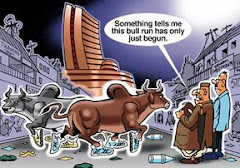
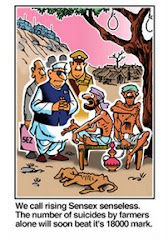
US investors had such a frightful October that the arrival of Halloween is actually a relief. At least the whole ghoulish month is over.
The Dow Jones Industrial Average has swung between gains and losses so far on Friday, trading 104 points higher in recent action, up 1.1%, at 9284.23 despite a round of weak economic data that reinforced many participants' perception that a persistent global slowdown is underway.
Friday, October 31, 2008
Sensex ends up 744pts; M&M zooms 23%
The Sensex opened with a positive gap of 317 points at 9,362, on the back of on-going pull-back in the market. Intra-day profit taking saw the index pare gains during the day, the Sensex however ended on a firm note at 9,788 - up 744 points
With today's gain, the main index of the Bombay Stock Exchange, the Sensex, gained over 27% (2,091 points) from it's Monday low of 7,697. However, the index was down almost 24% (3,072 points) for the month, and down nearly 52% (10,499 points) so far this year.
The BSE Metal index surged over 10% to 5,368, and Oil & Gas index soared over 9% to 6,196.
The market breath was fairly positve - out of 2,575 stocks traded, 1,577 advanced, 915 declined and the rest were unchanged today.
MAJOR INDEX MOVERS...
Mahindra & Mahindra zoomed 23% to Rs 372.
HDFC soared 17.5% to Rs 1,765, and Jaiprakash Associates surged 16.5% to Rs 72.
ICICI Bank rallied 15.5% to Rs 399. Sterlite gained 14.5% at Rs 282.
Reliance and Reliance Communications moved up 13.8% each to Rs 1,371 and Rs 221, respectively.
Hindalco advanced over 13% to Rs 60. Tata Steel and Tata Power were up around 12% each at Rs 210 and Rs 690, respectively.
...OTHER INDEX MOVERS
Tata Motors surged over 9% to Rs 172. DLF and BHEL rallied 8.8% each to Rs 220 and Rs 1,282, respectively.
HDFC Bank gained over 8% at Rs 1,024. Satyam added 7.6% to Rs 305.
Hindustan Unilever advanced 6.6% to Rs 222. Reliance Infrastructure, Wipro and Infosys were up around 6% each to Rs 457, Rs 272 and Rs 1,382, respectively.
Larsen & Toubro and Bharti Airtel gained 5.5% each at Rs 805 and Rs 649, respectively. NTPC was up nearly 5% at Rs 141.
...AND THE SHAKERS
Ranbaxy slipped 2% to Rs 169. TCS was down 1% at Rs 537.
MOST ACTIVE COUNTERS
Reliance topped the value chart with a turnover of Rs 435.80 crore followed by Reliance Capital (Rs 187 crore), ICICI Bank (Rs 170.60 crore), SBI (Rs 148.40 crore and Reliance Communications (Rs 135.60 crore).
Suzlong led the volume chart with trades of around 1.69 crore shares followed by Hindalco (1.34 crore), Reliance Petroleum (1 crore), Unitech (85 lakh) and Core Projects (81.37 lakh).
With today's gain, the main index of the Bombay Stock Exchange, the Sensex, gained over 27% (2,091 points) from it's Monday low of 7,697. However, the index was down almost 24% (3,072 points) for the month, and down nearly 52% (10,499 points) so far this year.
The BSE Metal index surged over 10% to 5,368, and Oil & Gas index soared over 9% to 6,196.
The market breath was fairly positve - out of 2,575 stocks traded, 1,577 advanced, 915 declined and the rest were unchanged today.
MAJOR INDEX MOVERS...
Mahindra & Mahindra zoomed 23% to Rs 372.
HDFC soared 17.5% to Rs 1,765, and Jaiprakash Associates surged 16.5% to Rs 72.
ICICI Bank rallied 15.5% to Rs 399. Sterlite gained 14.5% at Rs 282.
Reliance and Reliance Communications moved up 13.8% each to Rs 1,371 and Rs 221, respectively.
Hindalco advanced over 13% to Rs 60. Tata Steel and Tata Power were up around 12% each at Rs 210 and Rs 690, respectively.
...OTHER INDEX MOVERS
Tata Motors surged over 9% to Rs 172. DLF and BHEL rallied 8.8% each to Rs 220 and Rs 1,282, respectively.
HDFC Bank gained over 8% at Rs 1,024. Satyam added 7.6% to Rs 305.
Hindustan Unilever advanced 6.6% to Rs 222. Reliance Infrastructure, Wipro and Infosys were up around 6% each to Rs 457, Rs 272 and Rs 1,382, respectively.
Larsen & Toubro and Bharti Airtel gained 5.5% each at Rs 805 and Rs 649, respectively. NTPC was up nearly 5% at Rs 141.
...AND THE SHAKERS
Ranbaxy slipped 2% to Rs 169. TCS was down 1% at Rs 537.
MOST ACTIVE COUNTERS
Reliance topped the value chart with a turnover of Rs 435.80 crore followed by Reliance Capital (Rs 187 crore), ICICI Bank (Rs 170.60 crore), SBI (Rs 148.40 crore and Reliance Communications (Rs 135.60 crore).
Suzlong led the volume chart with trades of around 1.69 crore shares followed by Hindalco (1.34 crore), Reliance Petroleum (1 crore), Unitech (85 lakh) and Core Projects (81.37 lakh).

Thursday, October 30, 2008
Japan Stocks Rise; Nikkei Posts Biggest 3-Day Rally in 38 Years
Japan stocks soared today, sending the Nikkei 225 Stock Average to its sharpest three-day advance in at least 38 years, as a gain in commodity prices and a weaker yen boosted the profit prospects for resource companies and carmakers.
Mitsubishi Corp. and Mitsui & Co., trading companies that get more than half their profit from commodities, soared more than 12 percent. Mazda Motor Corp., which exports 80 percent of its production, jumped 25 percent, the most in at least three decades, after the yen weakened to 99.12 against the dollar. Mobile carrier Softbank Corp. surged by its limit of 13 percent after saying it will generate positive cash flow from this year.
The Nikkei 225 climbed 817.86, or 10 percent, to close at 9,029.76 in Tokyo, the fourth-biggest gain in its 59-year history. The broader Topix index rose 69.05, or 8.3 percent, to 899.37. The Nikkei had fallen 41 percent in the past six months, steeper than the Standard & Poor's 500 Index's 33 percent slide and a 34 percent drop in Europe's Dow Jones Stoxx 600 Index.
``Japan's market will likely rebound faster as it has slumped more than other major markets'' said Masaru Hamasaki, senior strategist at Toyota Asset Management Co. in Tokyo, which manages about $15 billion. If the yen stays at about 100 versus the dollar, ``it'll lead to a decline in material costs in a few months' time, benefiting manufacturers.''
The Nikkei 225 posted a three-day gain of 26 percent, the steepest since Nikkei Inc. took over the benchmark from the Tokyo Stock Exchange in July 1970. Even so, the measure is on track to record its worst month in that history, losing 19 percent. Six of the 10 biggest moves in the gauge in that period occurred this month, including a record 14 percent jump on Oct. 14.
Mitsubishi Corp. and Mitsui & Co., trading companies that get more than half their profit from commodities, soared more than 12 percent. Mazda Motor Corp., which exports 80 percent of its production, jumped 25 percent, the most in at least three decades, after the yen weakened to 99.12 against the dollar. Mobile carrier Softbank Corp. surged by its limit of 13 percent after saying it will generate positive cash flow from this year.
The Nikkei 225 climbed 817.86, or 10 percent, to close at 9,029.76 in Tokyo, the fourth-biggest gain in its 59-year history. The broader Topix index rose 69.05, or 8.3 percent, to 899.37. The Nikkei had fallen 41 percent in the past six months, steeper than the Standard & Poor's 500 Index's 33 percent slide and a 34 percent drop in Europe's Dow Jones Stoxx 600 Index.
``Japan's market will likely rebound faster as it has slumped more than other major markets'' said Masaru Hamasaki, senior strategist at Toyota Asset Management Co. in Tokyo, which manages about $15 billion. If the yen stays at about 100 versus the dollar, ``it'll lead to a decline in material costs in a few months' time, benefiting manufacturers.''
The Nikkei 225 posted a three-day gain of 26 percent, the steepest since Nikkei Inc. took over the benchmark from the Tokyo Stock Exchange in July 1970. Even so, the measure is on track to record its worst month in that history, losing 19 percent. Six of the 10 biggest moves in the gauge in that period occurred this month, including a record 14 percent jump on Oct. 14.
World market rise...
European stocks rose early today amid signs central banks around the globe will act further to prop up market confidence and lower borrowing costs for both consumers and businesses.
Shortly after the start of trading, the Dow Jones Stoxx 600 Index was 0.9% higher at 215.59. In terms of national markets, the U.K.'s FTSE 100 Index gained 0.45% to 4261.59, France's CAC-40 Index advanced 1.1% to 3439.80 and Germany's DAX Index rose 1.8% to 4896.74.
Asia closed with gains across the board. Asian investors cheered global efforts to deal with the credit crisis and slowing world economy, sending markets up sharply today in Tokyo, Hong Kong and Seoul.
Shortly after the start of trading, the Dow Jones Stoxx 600 Index was 0.9% higher at 215.59. In terms of national markets, the U.K.'s FTSE 100 Index gained 0.45% to 4261.59, France's CAC-40 Index advanced 1.1% to 3439.80 and Germany's DAX Index rose 1.8% to 4896.74.
Asia closed with gains across the board. Asian investors cheered global efforts to deal with the credit crisis and slowing world economy, sending markets up sharply today in Tokyo, Hong Kong and Seoul.
Dow Jones falls despite Fed rate cut
The US stock markets ended mixed on Wednesday after posting huge gains on Tuesday. The Fed's interest rate cut didn't help the Dow Jones, which declined 0.8% to 8991 points. Most of these losses, over 300 points, came in the last few minutes of trading.
The Nasdaq gained half a per cent to 1,651 points.
Indian ADRs were also mixed. Tata Communications gained 8.4% and Tata Motors was up 4.25%. HDFC Bank and ICICI Bank declined 4.2% and 4% respectively. Dr Reddy's also lost 3.7%, while Infosys was down 0.9%.
The Nasdaq gained half a per cent to 1,651 points.
Indian ADRs were also mixed. Tata Communications gained 8.4% and Tata Motors was up 4.25%. HDFC Bank and ICICI Bank declined 4.2% and 4% respectively. Dr Reddy's also lost 3.7%, while Infosys was down 0.9%.
News...
- Dow Jones falls despite Fed rate cut
- Inflation at 10.68%
- US Fed Reserve cuts 50 basis pts to 1%
- Chinese company to set up power production facility in India
- SBI to expand network in UP
- Champagne Indage Q2 net P up 9%t at Rs 5 crore
- FM reviews global fin crisis with key heads, experts
- No fuel price cut for now: Oil Ministry
- M&M consolidated Q2 net down 5%
- Indian oil firms to get oil bonds worth Rs 65,942 cr
- Telenor buys 61% stake in Unitech Wireless for Rs 6,120 cr
- US Fed eyes new rate cut to ease credit crisis
- Inflation at 10.68%
- US Fed Reserve cuts 50 basis pts to 1%
- Chinese company to set up power production facility in India
- SBI to expand network in UP
- Champagne Indage Q2 net P up 9%t at Rs 5 crore
- FM reviews global fin crisis with key heads, experts
- No fuel price cut for now: Oil Ministry
- M&M consolidated Q2 net down 5%
- Indian oil firms to get oil bonds worth Rs 65,942 cr
- Telenor buys 61% stake in Unitech Wireless for Rs 6,120 cr
- US Fed eyes new rate cut to ease credit crisis
Monday, October 27, 2008
Sensex on roller-coster ride, settles 191 pts down

Weighed under selling pressure from funds, Bombay Stock Exchange benchmark Sensex today went on a roller-coster ride yet again, falling over 1,000 points to breach the crucial 8,000 level in intra-day trading, but later recovered some losses on renewed buying. In a choppy trade, the 30-share index, which had lost over 1,000 points during the mid-session on major sell-off by funds, attracted some buying at the existing lower levels only to regain 812.17-point losses and closed at 8,509.56 level, 191.51 points down from the last week's close.
It touched the day's low of 7,697.39, a level last seen on October 2005. Similarly, the wide-based National Stock Exchange index Nifty dropped below 2,300 points before ending at 2524.20, still showing a loss of 59.50 points.
Marketmen said emergence of buying by domestic financial institutions and covering up of short positions by speculators at prevailing lower levels helped Sensex recover part of the lost ground. They said a steep fall in equities drove down the rupee against the dollar and gold also fell sharply, thus leaving no other option for investors but to return to the bourses.
A remarkable recovery was seen in the realty sector, which had suffered heavy losses during the day. The realty index bounced back to close higher by 74.01 points at 1,817.28 as stocks of Unitech, Indiabulls Realestate, Omax and Akruti City closed with handsome gains.
Saturday, October 25, 2008
Fresh Tumult as Signs of Recession Go Global

There are no safe havens from the forces battering the global economy any longer.
In rich countries and poor countries alike, markets are plunging, companies are scrambling for credit and cutting their growth plans and consumers are keeping cash in their pockets. The U.S. and some governments in Europe and Asia are spending heavily to bring a halt to the problems in markets and Main Streets globally, but the attempts have not halted the damage.
Stock declines started in Asia and quickly spread as markets opened for trading around the world.
Fears of a prolonged recession pushed shares down across the world on Friday. The slide started in Asia, where the benchmark Nikkei Stock Average fell 9.6% to a five-year low of 7649.08, and markets in Hong Kong, Mumbai and Seoul registered similar declines. Europe followed next, where the pan-European Dow Jones Stoxx 600 Index fell 4.7% to 198.80, dropping below 200 for the first time since mid 2003. In the U.S., the Dow Jones Industrial Average fell 312 points, or 3.6%, to finish at 8378.95, a 5 1/2-year low.
Disappointing economic statistics released Friday fed the sense of malaise. In Europe, a closely-watched survey of economic activity, the Markit Purchasing Managers' Index, fell to its lowest level in a decade in October. In the U.S., sales of previously occupied homes rose 1.4% from a year earlier in September, as bargain hunters started nibbling. But that news was eclipsed by the fact that there's still a huge glut of homes and credit remains tight. In Asia, currencies sank across the continent, deepening fears that companies would have a tougher time paying off debt that is in dollars and euros.
One big exception was Japan, where the yen jumped to a 13-year high, and was at 94.6 yen to the dollar late Friday in New York. But the gain stoked fear that the Japanese export machine will sputter further because its exports will be more expensive when measured in dollars.
Japan's deepening pessimism came just a few weeks after big firms started uncharacteristically bold overseas acquisitions. Last month, Nomura Holdings Inc. snapped up parts of bankrupt Lehman Brothers Holdings Inc. in Asia and Europe. Nomura's ebullient chief executive Kenichi Watanabe said in an interview he was looking at other possible acquisitions. But even though the strong yen makes overseas assets cheaper, there is a chance that Japanese companies may hunker down, removing another potential rescue force for ailing companies elsewhere.
While markets have been tumbling for some time, Friday seemed to be a day when many people around the world became convinced the economy is in for a long recession. That sense was exacerbated by poor earnings results and news of deep layoffs. Central banks in Europe and the U.S. are hinting broadly at further interest-rate cuts, while government officials in the U.S., Europe and Asia also are plotting further action. But that wasn't enough to calm fears around the globe.
Wkly Review: Sensex at 3-yr low, sheds 13%

The stock markets almost hit their bottom, falling to nearly three-year low at the weekend as the recession worries continued to haunt investors across the world even as the salvage operation undertaken by various governments fell short of expectations
In the week to October 25, the Bombay Stock Exchange 30-share bellwether Sensex plunged by 1,274 points or 12.8 per cent to settle the week at 8,701, the level not seen since November 23, 2005, when it had closed at 8,638.
The broader 50-share Nifty of the National Stock Exchange also tumbled by 490 points or 16 per cent to end the week at 2,584 from its last close.
The market saw a free fall as its global counterparts slipped on daily basis even as the Reserve Bank of India (RBI) said the present global financial markets crisis seems to be spreading across markets, institutions and countries, a day before announcing its mid-term review of monetary policy.
Contrary to expectations of further monetary measures, the apex bank kept all the key rates unchanged while lowering its growth projections to 7.5-8.0 per cent for this fiscal.
After infusing Rs one lakh crore in the banking system through a sharp 2.5 per cent CRR cut on October 11, the RBI slashed the short-term repo rate at which banks borrow from it to eight per cent on October 20.
The market regulator Sebi too took steps in the interest of capital market during the week. Sebi warned foreign funds against overseas lending and borrowing of Indian securities after the data showed that FIIs had lent equities worth Rs 348 crore to overseas entities for the purpose of short selling.
The central bank also eased norms on overseas borrowing for Indian companies to boost inflows and help corporates raise funds for projects.
Analysts said the market situation seems grim with all the global markets under pressure due to an imminent economic recession and spreading financial markets crisis beyond the banking sector.
British Chancellor Alistair Darling said that UK was nearing recession after official data revealed a 0.5 per cent decline in GDP for the July-September quarter. The data comes after IMF suggested that US economy would be in recession between second half of 2008 and first half of 2009.
The Dow Jones Industrial Average was down 312 points or 3.6 per cent on Friday.
On the BSE, there was a single gainer in the Sensex pack with half of them showing one of the biggest losses at the weekend. The BSE Realty stocks were the worst hit during the week. As a result, the BSE Realty Index crumbled by 781.62 points or 31 per cent.
The Metal Index tumbled by 1,407.83 points or 24.27 per cent, the BSE Oil&Gas by 1,327.92 points or 20.5 per cent and the BSE Auto Index by 6618.64 points or 20 per cent.
The broad-based BSE-100 Index slumped by 721.90 points or 14 per cent to end the week at 4,458.94 from its last weekend's close.
On the NSE, the S&P CNX Defty nosedived by 388.10 points or 17.82 per cent to close the week at 1,790.35 from its last close of 2,178.45 and the CNX Nifty Junior also dipped to settle the week at 4,104.45, a net fall of 566.00 points or 12.12 per cent from its previous weekend's close.
News
- Sensex at 3-yr low, sheds 13% this week
- NASA may set up R&D centre in Pune
- Grasim cuts VSF production by 30%
- Gold bounces back by Rs 500 per ten grams
- Jet Airways net loss rises to Rs 384.5 cr
- Sun Pharma net up 135% at Rs 513 cr
- US govt to buy stake in insurance companies
- Corporation Bank Q2 net up 19% at Rs 192 cr
- Arvind net down 84% at Rs 2 cr
- Era Infra bags Rs 199 cr order from BHEL
- Union Bank of India net up 31% at Rs 361 cr
- India not in recessionary mode: Subbarao (RBI Governor)
- NASA may set up R&D centre in Pune
- Grasim cuts VSF production by 30%
- Gold bounces back by Rs 500 per ten grams
- Jet Airways net loss rises to Rs 384.5 cr
- Sun Pharma net up 135% at Rs 513 cr
- US govt to buy stake in insurance companies
- Corporation Bank Q2 net up 19% at Rs 192 cr
- Arvind net down 84% at Rs 2 cr
- Era Infra bags Rs 199 cr order from BHEL
- Union Bank of India net up 31% at Rs 361 cr
- India not in recessionary mode: Subbarao (RBI Governor)
Thursday, October 23, 2008
Shares hit new low for 2008...

The Bombay Stock Exchange (BSE) fell to its lowest since June 2006 on Thursday as a global rout of equities raised worries of further foreign investor selling, before some bargain hunting helped the market regain some composure.
Leading private sector firm the Reliance Industries, which reports quarterly results after market hours, was down 3.9 percent at 1,264.70, having earlier fallen as much as 6.4 percent to its lowest since Dec. 2006.
The company is forecast to report a modest 2.2 percent rise in net profit on slimmer refining margins.
Asian stocks dropped to a four-year low for a second day today, with exporters especially hard hit, on growing fears that a severe global downturn would depress corporate earnings further.
Analysts said that they were expecting that the Indian stock would fall at the open as Japan's Nikkei stock index plunged to a new five-and-half year low amid fears of recession.
"Today's meltdown , we can see, again due to very weak global cues, it seems that the problem is too serious, whatever the governments are taking measures are not sufficient because they are not reflecting on the market," said Siddhart Kunawala, a stock analyst.
The 30-share BSE index opened down 4.8 percent and fell as far as 9,682.40, but by 10:59 a.m. had pared its losses to be down 2.07 percent 9,959.83. The market, however, closed near the day's lows - well under 9,800 levels.
The index is down by over half in 2008, with foreigners selling a net of 12.2 billion dollars in stocks so far this year, largely reversing 2007's record net buying of 17.4 billion dollars.

Tuesday, October 21, 2008
News
- Sensex ends up 460pts; Jaiprakash, TCS soar.
- Wockhardt's Sep qtr net down 44% to Rs 55cr.
- Telcos will have to pay for spectrum beyond 6.2 MHz: Raja.
- India to source uranium from Kazakhstan, Uzbekistan and Nigeria.
- Stock market news: DIIs net buyers of Rs 884cr in cash mkt today.
- Airlines to pay Rs 30,000 for abrupt flight cancellation.
- NIIT PAT up 41% at Rs 29.7 cr.
- World Bank appoints Pulock Chatterji as executive director.
- LIC Housing Finance Q2 net up 16% at Rs 135 cr.
- Global M&A volume reaches $3 trillion mark.
- Petroleum Minister Deora to meet Aviation Minister Patel, oil cos, airlines tomorrow to sort out fuel bills issue. "We don't want airlines to shut down operations," Deora has said.
- Wockhardt's Sep qtr net down 44% to Rs 55cr.
- Telcos will have to pay for spectrum beyond 6.2 MHz: Raja.
- India to source uranium from Kazakhstan, Uzbekistan and Nigeria.
- Stock market news: DIIs net buyers of Rs 884cr in cash mkt today.
- Airlines to pay Rs 30,000 for abrupt flight cancellation.
- NIIT PAT up 41% at Rs 29.7 cr.
- World Bank appoints Pulock Chatterji as executive director.
- LIC Housing Finance Q2 net up 16% at Rs 135 cr.
- Global M&A volume reaches $3 trillion mark.
- Petroleum Minister Deora to meet Aviation Minister Patel, oil cos, airlines tomorrow to sort out fuel bills issue. "We don't want airlines to shut down operations," Deora has said.
Saturday, October 18, 2008
Dow Ends Rocky Week in Black
Dow Jones Industrial Average past 12 months chart:

US stocks declined Friday but held on to solid gains for the week, as investors wondered how badly the economy is ailing, and when it is going to recover.
The Dow Jones Industrial Average remained volatile Friday, swinging in a 563-point range including big gains and losses. A late-day swoon left the blue-chip measure down 127.04 points at the closing bell, off 1.4%, at 8852.22. Caterpillar was the Dow's weakest component on Friday, off 7.2% following a round of downbeat housing data. The average's financial names all finished lower as well, hurt by lingering worries about the credit crunch. Citigroup was the weakest of that group, off 6.4%.
But for the week, the Dow rose 4.8%, its first such gain since the meltdown of Lehman Brothers Holdings set off a global financial crisis in mid-September. The gain was also the Dow's biggest weekly rise in percentage terms since March 2003.
Although the global economy's weakness remains deep-seated for now, the timing of a potential turnaround also remains a hot topic of debate on Wall Street, with some investors placing early bets on a rebound both in the U.S. and overseas.
"Based on what we're seeing, the second half of this year is shaping up to be really, really bad," said Deutsche Bank economist Joe LaVorgna. "But it could also be so bad that it wipes out any remaining imbalances. What you'll be left with is a lot of pent-up demand."
Pump prices have generally been on the decline lately, but other pressures remain for consumers whose buying activity represents more than two-thirds of the overall U.S. economy. Employment has fallen for nine straight months, the struggles of major financial institutions have made it more difficult to get credit, and lower home prices have cut into the wealth of many families.
On Friday, the Commerce Department reported that construction of new dwellings dropped 6.3% last month to the slowest pace since January 1991, when the U.S. was in the midst of an eight-month recession and going through another painful housing correction.
However, that recession was brief by historical standards, unlike the scenario worrying some investors and analysts who say the current slump could last several years. Mr. LaVorgna said he believes those fears are overblown, with a recovery possible perhaps in the second quarter of 2009.
Similar sentiments were evident in a column in Friday's New York Times by renowned investor Warren Buffett, who recommended buying U.S. stocks. The billionaire said that his entire personal fortune may soon be invested in the domestic market in anticipation of an economic recovery.
"If you wait for the robins, spring will be over," wrote Mr. Buffett. "Bad news is an investor's best friend. It lets you buy a slice of America's future at a marked-down price."
Other stock measures slipped Friday but finished with weekly gains. The S&P 500 fell 0.6% to 940.55, up 4.6% on the week. The broad measure was hurt Friday by a 2.9% drop in its financial sector, although gains in basic materials and energy, up 2.7% and 2.2% respectively, kept the S&P's daily decline in check.
The technology-oriented Nasdaq Composite Index was down 0.4% for the day, ending at 1711.29, up 3.7% on the week. The small-stock Russell 2000 tumbled 1.9% to 526.43, up 0.8% on the week.
More instability is expected in the market in the weeks ahead. The Chicago Board Options Exchange's Volatility Index, which uses options prices to measure investors' nervousness about upcoming stock-market swings, was up about 4%, ending at 70.33.
Options contracts on individual stocks and major indexes expired on Friday, which added wider-than-normal swings in the market. Traders must buy or sell shares to offset their expiring options bets.
The credit markets showed further signs of easing, although traders and analysts warned that conditions could remain stop-and-go awhile longer. The British Bankers Association quoted Libor -- a key interbank lending rate -- at 4.41875% for three-month loans of U.S. dollars, down from Thursday's fixing of 4.5025%. The one-month rate fell to 4.18125% from 4.2775%.
But those rates are still well above the levels seen before the failure of Lehman Brothers and before the Federal Reserve and its overseas colleagues carried out their coordinated rate cuts.

US stocks declined Friday but held on to solid gains for the week, as investors wondered how badly the economy is ailing, and when it is going to recover.
The Dow Jones Industrial Average remained volatile Friday, swinging in a 563-point range including big gains and losses. A late-day swoon left the blue-chip measure down 127.04 points at the closing bell, off 1.4%, at 8852.22. Caterpillar was the Dow's weakest component on Friday, off 7.2% following a round of downbeat housing data. The average's financial names all finished lower as well, hurt by lingering worries about the credit crunch. Citigroup was the weakest of that group, off 6.4%.
But for the week, the Dow rose 4.8%, its first such gain since the meltdown of Lehman Brothers Holdings set off a global financial crisis in mid-September. The gain was also the Dow's biggest weekly rise in percentage terms since March 2003.
Although the global economy's weakness remains deep-seated for now, the timing of a potential turnaround also remains a hot topic of debate on Wall Street, with some investors placing early bets on a rebound both in the U.S. and overseas.
"Based on what we're seeing, the second half of this year is shaping up to be really, really bad," said Deutsche Bank economist Joe LaVorgna. "But it could also be so bad that it wipes out any remaining imbalances. What you'll be left with is a lot of pent-up demand."
Pump prices have generally been on the decline lately, but other pressures remain for consumers whose buying activity represents more than two-thirds of the overall U.S. economy. Employment has fallen for nine straight months, the struggles of major financial institutions have made it more difficult to get credit, and lower home prices have cut into the wealth of many families.
On Friday, the Commerce Department reported that construction of new dwellings dropped 6.3% last month to the slowest pace since January 1991, when the U.S. was in the midst of an eight-month recession and going through another painful housing correction.
However, that recession was brief by historical standards, unlike the scenario worrying some investors and analysts who say the current slump could last several years. Mr. LaVorgna said he believes those fears are overblown, with a recovery possible perhaps in the second quarter of 2009.
Similar sentiments were evident in a column in Friday's New York Times by renowned investor Warren Buffett, who recommended buying U.S. stocks. The billionaire said that his entire personal fortune may soon be invested in the domestic market in anticipation of an economic recovery.
"If you wait for the robins, spring will be over," wrote Mr. Buffett. "Bad news is an investor's best friend. It lets you buy a slice of America's future at a marked-down price."
Other stock measures slipped Friday but finished with weekly gains. The S&P 500 fell 0.6% to 940.55, up 4.6% on the week. The broad measure was hurt Friday by a 2.9% drop in its financial sector, although gains in basic materials and energy, up 2.7% and 2.2% respectively, kept the S&P's daily decline in check.
The technology-oriented Nasdaq Composite Index was down 0.4% for the day, ending at 1711.29, up 3.7% on the week. The small-stock Russell 2000 tumbled 1.9% to 526.43, up 0.8% on the week.
More instability is expected in the market in the weeks ahead. The Chicago Board Options Exchange's Volatility Index, which uses options prices to measure investors' nervousness about upcoming stock-market swings, was up about 4%, ending at 70.33.
Options contracts on individual stocks and major indexes expired on Friday, which added wider-than-normal swings in the market. Traders must buy or sell shares to offset their expiring options bets.
The credit markets showed further signs of easing, although traders and analysts warned that conditions could remain stop-and-go awhile longer. The British Bankers Association quoted Libor -- a key interbank lending rate -- at 4.41875% for three-month loans of U.S. dollars, down from Thursday's fixing of 4.5025%. The one-month rate fell to 4.18125% from 4.2775%.
But those rates are still well above the levels seen before the failure of Lehman Brothers and before the Federal Reserve and its overseas colleagues carried out their coordinated rate cuts.
Thursday, October 2, 2008
Senate Vote Gives Bailout Plan New Life
Passage Gets Boost From Tax Breaks; Back to the House
The Senate handily passed a controversial financial rescue package on Wednesday, giving the bill its first legislative victory but adding provisions that could complicate efforts to push the $700 billion plan through the House of Representatives.
The compromise bill represented a marriage of the rescue proposal with a host of measures designed to win the support of reluctant lawmakers. Additions include an increase in bank deposit insurance limits, a suggested change to accounting rules, and a $150.5 billion package of unrelated personal and corporate tax cuts.
The additions boosted support in the Senate, which voted 74 to 25 in favor, the latest twist in the proposal's roller-coaster ride this week. Opposition came from conservatives, populists and senators facing tight races where the rescue bill is drawing criticism.
Senate Majority Leader Harry Reid of Nevada said he expected the House would pass the bill, a sentiment echoed by other senators. House leaders expressed cautious optimism they could secure passage, but couldn't be definitive.
President George W. Bush has called the plan vital to secure the proper functioning of financial markets. But lawmakers and the administration have spent more than a week wrangling over the proposal amid a backlash from voters. The disagreements culminated in the unexpected rejection by the House on Monday, in defiance of congressional leaders and the White House, triggering the stock market to sink.

Stunned by the market response, lawmakers regrouped and added new items to the bill to win votes. Senate leaders took up the bill, which had stronger support in that chamber, with the aim of putting pressure on the House. Presidential rivals Republican Sen. John McCain and Democratic Sen. Barack Obama flew back to the Capitol to cast votes in favor.
The 10-year, $150.5 billion package of tax proposals includes a measure to ease the bite of the alternative minimum tax, as well as research-and-development tax credits coveted by high-tech companies and drug makers. Its addition is designed to secure the support of Republicans, who were overwhelmingly opposed in the House. But it could irk conservative House Democrats because the measure will add to the deficit.
The bill also reaffirms the Securities and Exchange Commission's authority to suspend so-called mark-to-market accounting, an issue that gained surprising traction among lawmakers looking for less costly alternatives to the Bush plan. The practice, adopted in the aftermath of the savings-and-loan collapse in the 1980s, pegs the value of assets to their current market price, rather than the price paid for them.
Banks have complained the strict application of mark-to-market rules have forced them to write down billions worth of mortgage-related securities for which there are no buyers, intensifying the squeeze in the credit markets.
The bill, which started out less than three pages long, now comprises more than 400 pages.
A senior House Democratic aide said he was "cautiously optimistic" but put the responsibility on Republicans to come up with more votes. A spokesman for Rep. John Boehner of Ohio, the minority leader, said: "We believe we have a better chance of passing this bill than the one on Monday, but we'll have to wait and see." The House could vote Thursday or Friday.
The core of Mr. Bush's rescue plan survives in the Senate bill. The measure authorizes Treasury to borrow $700 billion to buy up tainted mortgages, securities and other financial instruments that have weakened the financial system and frozen credit markets.
The Senate handily passed a controversial financial rescue package on Wednesday, giving the bill its first legislative victory but adding provisions that could complicate efforts to push the $700 billion plan through the House of Representatives.
The compromise bill represented a marriage of the rescue proposal with a host of measures designed to win the support of reluctant lawmakers. Additions include an increase in bank deposit insurance limits, a suggested change to accounting rules, and a $150.5 billion package of unrelated personal and corporate tax cuts.
The additions boosted support in the Senate, which voted 74 to 25 in favor, the latest twist in the proposal's roller-coaster ride this week. Opposition came from conservatives, populists and senators facing tight races where the rescue bill is drawing criticism.
Senate Majority Leader Harry Reid of Nevada said he expected the House would pass the bill, a sentiment echoed by other senators. House leaders expressed cautious optimism they could secure passage, but couldn't be definitive.
President George W. Bush has called the plan vital to secure the proper functioning of financial markets. But lawmakers and the administration have spent more than a week wrangling over the proposal amid a backlash from voters. The disagreements culminated in the unexpected rejection by the House on Monday, in defiance of congressional leaders and the White House, triggering the stock market to sink.

Stunned by the market response, lawmakers regrouped and added new items to the bill to win votes. Senate leaders took up the bill, which had stronger support in that chamber, with the aim of putting pressure on the House. Presidential rivals Republican Sen. John McCain and Democratic Sen. Barack Obama flew back to the Capitol to cast votes in favor.
The 10-year, $150.5 billion package of tax proposals includes a measure to ease the bite of the alternative minimum tax, as well as research-and-development tax credits coveted by high-tech companies and drug makers. Its addition is designed to secure the support of Republicans, who were overwhelmingly opposed in the House. But it could irk conservative House Democrats because the measure will add to the deficit.
The bill also reaffirms the Securities and Exchange Commission's authority to suspend so-called mark-to-market accounting, an issue that gained surprising traction among lawmakers looking for less costly alternatives to the Bush plan. The practice, adopted in the aftermath of the savings-and-loan collapse in the 1980s, pegs the value of assets to their current market price, rather than the price paid for them.
Banks have complained the strict application of mark-to-market rules have forced them to write down billions worth of mortgage-related securities for which there are no buyers, intensifying the squeeze in the credit markets.
The bill, which started out less than three pages long, now comprises more than 400 pages.
A senior House Democratic aide said he was "cautiously optimistic" but put the responsibility on Republicans to come up with more votes. A spokesman for Rep. John Boehner of Ohio, the minority leader, said: "We believe we have a better chance of passing this bill than the one on Monday, but we'll have to wait and see." The House could vote Thursday or Friday.
The core of Mr. Bush's rescue plan survives in the Senate bill. The measure authorizes Treasury to borrow $700 billion to buy up tainted mortgages, securities and other financial instruments that have weakened the financial system and frozen credit markets.
Monday, September 29, 2008
U.S. Seals Bailout Deal
The White House and congressional leaders agreed on a deal to authorize the biggest banking rescue in U.S. history.
The $700 billion program would effectively nationalize an array of mortgages and securities backed by them -- instruments whose deteriorating value has clogged the nation's financial system.
Lawmakers finished writing the bill late Sunday, after which Speaker of the House Nancy Pelosi declared it "frozen," meaning no changes would be made. The bill leaves many mechanics of the operation up to the Treasury. Among these are the crucial issues of how the U.S. government would decide which assets it will buy and how it would decide what to pay for them. The legislation leaves the Treasury 45 days to issue guidelines on those procedures. The bill awaits votes in Congress starting on Monday.
From big Wall Street houses to small community banks, executives have expressed an interest in signing up for the bailout. But some have said the extent of their involvement will depend on critical details.
The political fallout from the bailout could be substantial, given the enormous expenditure of taxpayer money. Some polls show wide opposition. But the legislation includes provisions designed to guard against ultimate losses for the government. And it calls on the Treasury, as an owner of mortgage securities, to "encourage the servicers of the underlying mortgages" to minimize foreclosures.
The deal came after tension-filled weekend negotiations, where the specter of a faltering economy collided with the politics of a presidential election to create one of the biggest congressional dramas of recent years. Saturday included a high-decibel exchange between Treasury Secretary Henry Paulson and congressional Democrats, a ban on handheld email devices to forestall news leaks, and a battery of lobbying calls from the president and the presidential candidates.
The $700 billion program would effectively nationalize an array of mortgages and securities backed by them -- instruments whose deteriorating value has clogged the nation's financial system.
Lawmakers finished writing the bill late Sunday, after which Speaker of the House Nancy Pelosi declared it "frozen," meaning no changes would be made. The bill leaves many mechanics of the operation up to the Treasury. Among these are the crucial issues of how the U.S. government would decide which assets it will buy and how it would decide what to pay for them. The legislation leaves the Treasury 45 days to issue guidelines on those procedures. The bill awaits votes in Congress starting on Monday.
From big Wall Street houses to small community banks, executives have expressed an interest in signing up for the bailout. But some have said the extent of their involvement will depend on critical details.
The political fallout from the bailout could be substantial, given the enormous expenditure of taxpayer money. Some polls show wide opposition. But the legislation includes provisions designed to guard against ultimate losses for the government. And it calls on the Treasury, as an owner of mortgage securities, to "encourage the servicers of the underlying mortgages" to minimize foreclosures.
The deal came after tension-filled weekend negotiations, where the specter of a faltering economy collided with the politics of a presidential election to create one of the biggest congressional dramas of recent years. Saturday included a high-decibel exchange between Treasury Secretary Henry Paulson and congressional Democrats, a ban on handheld email devices to forestall news leaks, and a battery of lobbying calls from the president and the presidential candidates.
Saturday, September 27, 2008
Bailout Compromise Gets New Life
Courtesy - Wall Street Journel
Negotiations Resume, With Nod to Conservatives' Objections
WASHINGTON -- The Bush administration and Congress closed in on a new compromise aimed at stabilizing U.S. financial markets, a move designed to assuage conservatives who one day earlier had staged a revolt against the controversial $700 billion project.
The potential compromise isn't yet final, and details could change. But as of Friday night it appears that the plan's central elements, as originally envisioned by the Treasury Department, remain intact.
Congressional leaders were planning for possible votes Sunday.
The renewed effort represents a remarkable turnaround from the fracas that engulfed Washington Thursday night. In a sign of the political tensions at play, an earlier compromise plan was thrown into disarray after a White House meeting of top leaders -- including the two presidential candidates -- descended into a shouting match.
Republican nominee Sen. John McCain had returned to Washington to attend bailout negotiations. But the interjection of the presidential campaign, and the resulting finger-pointing, upset the delicate balance that had been struck in negotiations between congressional Democrats and Treasury Secretary Henry Paulson.
"I would hope the two presidentials would go to the debate tonight and leave us alone to get our work done here," said Sen. Harry Reid, a Nevada Democrat, sounding exhausted on the Senate floor Friday morning.
Under the Bush plan, the Treasury Department would be able to buy $700 billion of toxic investments currently burdening many financial institutions. The hope is that doing so would encourage investors to recapitalize the struggling banks, and get the nation's bond markets working again.
It would also, however, put taxpayers on the hook for potential losses if the investments bought by the government didn't later recover some of their value.
House Republicans, antsy about the power granted to the Treasury under that original plan, wanted to replace it with one based on an insurance model: Banks would pay premiums into a pool of money that would then be used to cover losses on the bad assets in question.
Treasury officials had earlier told lawmakers the concept was unworkable, people familiar with the matter said. Indeed, officials there briefly considered it, but concluded it wouldn't be as effective in clearing the rot from banks' balance sheets.
The compromise being hammered out Friday night would graft the insurance concept onto the original Treasury plan, most likely as an option. That would satisfy the administration, which could chose not to use it, as well as conservative lawmakers, who can claim to have influenced the legislation.
The White House has already agreed to other Democratic demands for the bailout, including greater oversight of the plan, and pay curbs for executives at some companies that benefit from the bailout.
The administration also agreed to a commitment to help struggling homeowners. And it agreed for the $700 billion to be released in installments; $250 billion would be made available immediately.
As Friday unfolded, Democrats signaled a willingness to consider including some version of the insurance proposal. "Adding insurance as an option...that's never been an issue," said Rep. Barney Frank (D., Mass.), chairman of the House Financial Services Committee and a lead negotiator.
At a late-afternoon news conference, House Speaker Nancy Pelosi sounded conciliatory, suggesting that Mr. Paulson should have "the latitude to accept any and all proposals," so long as they don't interfere with the core goals of the bailout plan.
The unexpected opposition from House Republicans on Thursday had thrown into chaos efforts to craft a rescue package for the financial markets. Democratic leaders of the House and Senate, after working with the Bush White House for several days on details, said they felt blindsided by the Republican move.
The face-off reflected years of tension between the Bush White House and House Republicans, and exposed the ideological differences within the Republican Party over the role of government in free markets.
President George W. Bush, who urged lawmakers to "rise to the occasion" Friday, has said his first instinct is to not intervene in the market. But he became convinced of the need after Mr. Paulson and Federal Reserve Chairman Ben Bernanke warned that the financial crisis could spread to Main Street from Wall Street and throw the country into a deep recession.
Many Senate Republicans, including Bob Bennett of Utah and Judd Gregg of New Hampshire, have tried to be supportive of the White House's efforts to find common ground with Democrats. But conservatives who dominate the Republican Party's caucus in the House have been less amenable, particularly those disaffected with the Bush administration's sizable domestic spending and the realities of life as a minority party.
Rep. Tom Davis (R., Va.) said Republicans have felt like "bystanders" the past two years and wanted to be brought into the negotiations as full partners. Democrats "have got to come and meet us halfway," he said.
By midweek, it became clear that only a couple dozen of the 199 House Republicans were likely to support the plan in its existing form.
House Republicans say their alternative proposal would bring stability and new capital to the market. It would also remove regulatory barriers that they say block private investors from investing capital into ailing financial institutions.
"We were simply trying to come up with a constructive solution to break an impasse," said Rep. Paul Ryan (R., Wis.), who outlined the plan to Sen. McCain in a meeting Thursday.
The struggle over the bailout bill represents one of the most dramatic congressional showdowns of recent years. In 1990, the Democratic House voted down a major deficit-reduction package backed by the administration of the first President Bush. The package was later brought back to the floor and approved, but only after changes that tilted the measure to the left.
A few years later, the Republican-controlled Congress balked at the Clinton administration's plans to help rescue Mexico's economy, forcing the administration to use other measures to achieve its goals.
At a closed-door meeting of House Republicans on Friday, House Minority Leader John Boehner and other party leaders received an ovation for having resisted pressure to support the Bush-backed package during a White House meeting the previous day.
Negotiations Resume, With Nod to Conservatives' Objections
WASHINGTON -- The Bush administration and Congress closed in on a new compromise aimed at stabilizing U.S. financial markets, a move designed to assuage conservatives who one day earlier had staged a revolt against the controversial $700 billion project.
The potential compromise isn't yet final, and details could change. But as of Friday night it appears that the plan's central elements, as originally envisioned by the Treasury Department, remain intact.
Congressional leaders were planning for possible votes Sunday.
The renewed effort represents a remarkable turnaround from the fracas that engulfed Washington Thursday night. In a sign of the political tensions at play, an earlier compromise plan was thrown into disarray after a White House meeting of top leaders -- including the two presidential candidates -- descended into a shouting match.
Republican nominee Sen. John McCain had returned to Washington to attend bailout negotiations. But the interjection of the presidential campaign, and the resulting finger-pointing, upset the delicate balance that had been struck in negotiations between congressional Democrats and Treasury Secretary Henry Paulson.
"I would hope the two presidentials would go to the debate tonight and leave us alone to get our work done here," said Sen. Harry Reid, a Nevada Democrat, sounding exhausted on the Senate floor Friday morning.
Under the Bush plan, the Treasury Department would be able to buy $700 billion of toxic investments currently burdening many financial institutions. The hope is that doing so would encourage investors to recapitalize the struggling banks, and get the nation's bond markets working again.
It would also, however, put taxpayers on the hook for potential losses if the investments bought by the government didn't later recover some of their value.
House Republicans, antsy about the power granted to the Treasury under that original plan, wanted to replace it with one based on an insurance model: Banks would pay premiums into a pool of money that would then be used to cover losses on the bad assets in question.
Treasury officials had earlier told lawmakers the concept was unworkable, people familiar with the matter said. Indeed, officials there briefly considered it, but concluded it wouldn't be as effective in clearing the rot from banks' balance sheets.
The compromise being hammered out Friday night would graft the insurance concept onto the original Treasury plan, most likely as an option. That would satisfy the administration, which could chose not to use it, as well as conservative lawmakers, who can claim to have influenced the legislation.
The White House has already agreed to other Democratic demands for the bailout, including greater oversight of the plan, and pay curbs for executives at some companies that benefit from the bailout.
The administration also agreed to a commitment to help struggling homeowners. And it agreed for the $700 billion to be released in installments; $250 billion would be made available immediately.
As Friday unfolded, Democrats signaled a willingness to consider including some version of the insurance proposal. "Adding insurance as an option...that's never been an issue," said Rep. Barney Frank (D., Mass.), chairman of the House Financial Services Committee and a lead negotiator.
At a late-afternoon news conference, House Speaker Nancy Pelosi sounded conciliatory, suggesting that Mr. Paulson should have "the latitude to accept any and all proposals," so long as they don't interfere with the core goals of the bailout plan.
The unexpected opposition from House Republicans on Thursday had thrown into chaos efforts to craft a rescue package for the financial markets. Democratic leaders of the House and Senate, after working with the Bush White House for several days on details, said they felt blindsided by the Republican move.
The face-off reflected years of tension between the Bush White House and House Republicans, and exposed the ideological differences within the Republican Party over the role of government in free markets.
President George W. Bush, who urged lawmakers to "rise to the occasion" Friday, has said his first instinct is to not intervene in the market. But he became convinced of the need after Mr. Paulson and Federal Reserve Chairman Ben Bernanke warned that the financial crisis could spread to Main Street from Wall Street and throw the country into a deep recession.
Many Senate Republicans, including Bob Bennett of Utah and Judd Gregg of New Hampshire, have tried to be supportive of the White House's efforts to find common ground with Democrats. But conservatives who dominate the Republican Party's caucus in the House have been less amenable, particularly those disaffected with the Bush administration's sizable domestic spending and the realities of life as a minority party.
Rep. Tom Davis (R., Va.) said Republicans have felt like "bystanders" the past two years and wanted to be brought into the negotiations as full partners. Democrats "have got to come and meet us halfway," he said.
By midweek, it became clear that only a couple dozen of the 199 House Republicans were likely to support the plan in its existing form.
House Republicans say their alternative proposal would bring stability and new capital to the market. It would also remove regulatory barriers that they say block private investors from investing capital into ailing financial institutions.
"We were simply trying to come up with a constructive solution to break an impasse," said Rep. Paul Ryan (R., Wis.), who outlined the plan to Sen. McCain in a meeting Thursday.
The struggle over the bailout bill represents one of the most dramatic congressional showdowns of recent years. In 1990, the Democratic House voted down a major deficit-reduction package backed by the administration of the first President Bush. The package was later brought back to the floor and approved, but only after changes that tilted the measure to the left.
A few years later, the Republican-controlled Congress balked at the Clinton administration's plans to help rescue Mexico's economy, forcing the administration to use other measures to achieve its goals.
At a closed-door meeting of House Republicans on Friday, House Minority Leader John Boehner and other party leaders received an ovation for having resisted pressure to support the Bush-backed package during a White House meeting the previous day.
Friday, September 26, 2008
Global leaders seek Indian PM's expertise to salvage financial crisis

With the world gripped in financial crisis, the expertise of Indian Prime Minister Manmohan Singh, a highly acclaimed economist, was much in demand as he met various leaders, including US President George Bush, in New York, where world leaders have gathered for the United Nations General Assembly.
Every leader the Prime Minister met sought his opinion on how to deal with the financial meltdown, Indian officials accompanying the Prime Minister have said.
The issue came up in a big way during his meeting with World Bank President Robert B Zoellick.
Singh, a World Bank economist-turned politician, is expected to speak on the subject in his presentation at the United Nations General Assembly.
Sensex shed 445pts; Realty, metal, banking stocks slide

The Sensex opened 65 points lower at 13,482 on weak cues from other Asian markets. Persistent weakness, thereafter, saw the index slip deeper into red as the day progressed.
Realty, metal and banking stocks bore the brunt of the selling pressure today. The Sensex dropped to a low of 13,054, and finally settled with a loss of 445 points at 13,102.
The BSE Realty index slumped 6.3% (243 points) to 3,597. The Metal index shed 4.8% (475 points) at 9,502, and the Bankex dropped 4.3% (293 points) to 6,571.
The market breadth was extremely negative - out of 2,673 stocks traded, 2,170 declined, 444 advanced and the rest were unchanged today.
INDEX SHAKERS...
Ranbaxy slumped 8% to Rs 272.
Sterlite, ICICI Bank and Grasim tumbled around 6% each to Rs 447, Rs 561 and Rs 1,761, respectively.
Hindalco, Mahindra & Mahindra, BHEL and DLF plunged around 5% each to Rs 99, Rs 531, Rs 1,551 and Rs 370, respectively.
Tata Steel, Reliance Communications and Maruti shed nearly 5% each at Rs 461, Rs 348 and Rs 671, respectively.
HDFC Bank, SBI, Larsen & Toubro and Infosys dropped around 4% each to Rs 1,246, Rs 1,434, Rs 2,468 and Rs 1,448, respectively.
HDFC and ONGC slipped 3.5% each to Rs 2,089 and Rs 1,035, respectively.
Reliance Infrastrcuture, Reliance, NTPC and Tata Motors were down around 3% each to Rs 850, Rs 1,961, Rs 174 and Rs 373, respectively.
...AND THE MOVERS
ITC surged 2% to Rs 192, and Hindustan Unilever was up over 1% at Rs 253.
VALUE & VOLUME TOPPERS
Reliance Capital topped the value chart with a turnover of Rs 478.70 crore followed by Reliance (Rs 373 crore), Axis Bank (Rs 170.40 crore), Jai Corp (Rs 167.55 crore) and Larsen & Toubro (Rs 144.55 crore).
IFCI led the volume chart with trades of around 96.75 lakh shares followed by Anant Raj Industries (87.80 lakh), Reliance Natural Resources (85.80 lakh), Sesa Goa (82 lakh) and Idea Cellular (65.80 lakh).
Tuesday, September 23, 2008
Kingfisher sacks 300 ex-Air Deccan employees
Three hundred employees of Air Deccan, now re-branded Kingfisher Red, are being laid off by Vijay Mallya-led Kingfisher Airlines, just weeks after the completion of merger between the two Bangalore-based carriers. On Monday morning, the staff at Bangalore and some other offices was asked to accept the severance package and resign.
The process would continue for a day or two. Many of these employees have been with Air Deccan for nearly five years.
According to Kingfisher spokesman, the retrenched employees include 200 security personnel, 50 airport services staff and 50 from the engineering department. These employees were given a severance package equal to two months gross salary for every completed year of service (subject to a minimum of 3 months pay-out).
A week ago JetLite had announced plans to cut 800 employees from its 2,300 workforce.
The process would continue for a day or two. Many of these employees have been with Air Deccan for nearly five years.
According to Kingfisher spokesman, the retrenched employees include 200 security personnel, 50 airport services staff and 50 from the engineering department. These employees were given a severance package equal to two months gross salary for every completed year of service (subject to a minimum of 3 months pay-out).
A week ago JetLite had announced plans to cut 800 employees from its 2,300 workforce.
Monday, September 22, 2008
PepsiCo announces $500 million investment in India
PepsiCo chairperson and chief executive Indra Nooyi has announced an investment of $500 million in India over the next three years to triple revenues by 2014.
The investment would be spread over manufacturing, market infrastructure, environment sustainability initiatives, research, new products and agriculture, Chennai-born Nooyi said.
'The new investment will contribute 50,000 new direct and indirect jobs to the Indian economy,' she said at a press conference here.
'India is among the top five market of PepsiCo and we remain extremely bullish on the country, she added
Nooyi is in India to chair the $39-billion food and beverages giant's two-day annual conclave from Monday.
Besides Nooyi, some of the top executives expected at the meeting include chief executive and vice chairman Michael D. White, senior vice president and general counsel Larry Thompson, and PepsiCo UK president Salman Amin.
PeosiCo, which entered India in 1989 mainly as a beverages company, has invested $700 million in the country so far. It has 43 bottling plants in India, of which the company owns 15, while the rest are operated by franchisees.
It also has three factories to manufacture the Frito-Lay range of potato chips, Cheetos extruded snacks, and traditional Indian snacks under the Kurkure and Lehar brands.
The investment would be spread over manufacturing, market infrastructure, environment sustainability initiatives, research, new products and agriculture, Chennai-born Nooyi said.
'The new investment will contribute 50,000 new direct and indirect jobs to the Indian economy,' she said at a press conference here.
'India is among the top five market of PepsiCo and we remain extremely bullish on the country, she added
Nooyi is in India to chair the $39-billion food and beverages giant's two-day annual conclave from Monday.
Besides Nooyi, some of the top executives expected at the meeting include chief executive and vice chairman Michael D. White, senior vice president and general counsel Larry Thompson, and PepsiCo UK president Salman Amin.
PeosiCo, which entered India in 1989 mainly as a beverages company, has invested $700 million in the country so far. It has 43 bottling plants in India, of which the company owns 15, while the rest are operated by franchisees.
It also has three factories to manufacture the Frito-Lay range of potato chips, Cheetos extruded snacks, and traditional Indian snacks under the Kurkure and Lehar brands.
Rs 1 lakh cr club shrinks
As the market continues to bleed, major Indian companies have lost significantly on market capitalisations and the prominent losers from the benchmark index at the Bombay stock exchange are DLF, ICICI Bank and Reliance Communications. Indian companies have lost significant value in market capitalisations since January 10 when the market started to slip.
There has been a significant fall in the number of companies that command market capitalisation of more than Rs 1,00,000 crore. The number has reduced from 13 to five since January 10.
Out of the list of 30 companies listed in the benchmark index at Bombay Stock Exchange - Sensex, only four companies form a part of the elite club now, which earlier stood at 10. The list includes two companies operating in oil sector that have been doing well on the back of rising oil prices -Reliance Industries and ONGC. The two others are - NTPC and Bharti Airtel.
Out of the Sensex companies that held a market cap above the Rs one lakh crore, DLF has been the biggest loser with two thirds of its value lost. ICICI Bank is the second biggest loser with a fall in value of 57 per cent.
By comparison, its nearest rival in the private sector -HDFC Bank has lost only 15 per cent since then. The third biggest loser is Reliance Communications, which has lost almost 55 per cent of its value.
In comparison Bharti Airtel, its competitor in the same industry has lost only 21 per cent of its value.
There has been a significant fall in the number of companies that command market capitalisation of more than Rs 1,00,000 crore. The number has reduced from 13 to five since January 10.
Out of the list of 30 companies listed in the benchmark index at Bombay Stock Exchange - Sensex, only four companies form a part of the elite club now, which earlier stood at 10. The list includes two companies operating in oil sector that have been doing well on the back of rising oil prices -Reliance Industries and ONGC. The two others are - NTPC and Bharti Airtel.
Out of the Sensex companies that held a market cap above the Rs one lakh crore, DLF has been the biggest loser with two thirds of its value lost. ICICI Bank is the second biggest loser with a fall in value of 57 per cent.
By comparison, its nearest rival in the private sector -HDFC Bank has lost only 15 per cent since then. The third biggest loser is Reliance Communications, which has lost almost 55 per cent of its value.
In comparison Bharti Airtel, its competitor in the same industry has lost only 21 per cent of its value.
Saturday, September 20, 2008
Wkly Review: Sensex recovers sharp losses, ends week on a +ve note

In a roller-coaster ride during the week under review, some positive developments at the fag-end of the week helped the benchmark Sensex to rebound from early sharp losses, ending with a gain of over 41 points.
Steps taken by US policymakers and other top central banks globally to pump billions of dollars to revive the scary financial system and positive statements by the local government, assisted the Sensex to recover from a nine-week low of 12,558.14 points to close the week above the 14K-level.
Marketmen said morale-boosting signals from New Delhi after a Cabinet meeting, chaired by Prime Minister Manmohan Singh, also boosted investor sentiment.
The PM's caution came during the Cabinet Committee on Economic Affairs meeting after Finance Minister P Chidambaram briefed about the financial crisis in US while stating the Indian economy was not affected by the developments.
Tracking global trends which rallied after regulators in the UK and US halted short-selling in financial stocks on late Thursday, boosted the badly battered investors' confidence which had touched rock bottom after the collapse of investment bank Lehman Brothers and distress sale of Merrill Lynch.
In the week to September 20, the Bombay Stock Exchange 30-share barometer recovered its early losses sharply to end the week at 14,042.32 points, a mere rise of 41.51 points or 0.30 per cent over the previous weekend close.
Similarly, the 50-share Nifty of the National Stock Exchange also recouped by 16.80 points or 0.40 per cent to close the week at 4,245.25 points from the last weekend close.
RIL, ONGC, HDFC Bank, HDFC, SBI, Bharti Airtel, ACC, Tata Motors, NTPC, Maruti Suzuki and Tata Powers were the major gainers from the Sensex pack, while Ranbaxy, DLF, Jaiprakash Associates, Grasim, Hindalco, ICICI Bank, Reliance Com, REL Infra, Satyam Computer, Sterlite, Tata Steel and TCS suffered a sharp to moderate setback.
Reflecting a rally in some of the refinery and banking counters, the BSE-Oil&Gas index rose by 351.98 points or 3.86 per cent and the Bankex by 80.66 points or 1.15 per cent.
Although a battered realty segment attracted good buying support on Friday, it was the biggest loser from the sectoral indices. BSE-Realty index tumbled by 591.08 points or 12.59 per cent followed by the BSE-Metal by 847.83 points or 7.79 per cent and the BSE-CD by 264.21 points or 7.39 per cent.
Depicting a heavy sell-off in small-cap and mid-cap counters, BSE-Smallcap index plunged by 495.55 points or 7.38 per cent and the BSE-Midcap by 308.36 points or 5.57 per cent.
The broad-based BSE-100 Index declined by 58.60 points or 0.80 per cent to end the week at 7,285.77 points from 7,344.37 points.
The BSE-200 Index and the Dollex-200 were also quoted further lower at 1,695.81 and 611.44 at the weekend compared to last weekend's close of 1,1717.28 and 626.44 respectively.
On the NSE, the S&P CNX Defty eased by 21.50 points or 0.67 per cent to close the week at 3,189.80 from 3,211.30 last weekend and the CNX Nifty Junior also ended the week down by 251.25 points or 3.67 per cent to 6,591.55 points from previous weekend's close of 6,842.80 points.
Among the sectoral indices, the BSE Metal Index nosedived by 904.35 points or 7.67 per cent to 10,881.42, the BSE Realty Index by 285.54 points or 5.73 per cent to 4,693.72, the BSE CD Index by 211.00 points or 5.57 per cent to 3,575.28 and the BSE Oil&Gas Index by 536.24 points or 5.56 per cent to 9,116.44.
Saturday, September 13, 2008
News...
- Wall St ends flat; Indian ADRs end mixed
- FIIs net sell Rs 777cr in F&O on Friday
- FII-TO-FII TRADES: Pantaloon traded at 26% premium
- Govt not to extend export freight assistance to sugar mills
- Industrial growth above expectation, chambers want rates cut
- Cheaper crude welcome; but no fuel price cut on cards: Deora
- Goldman Sachs expects RBI to up rates one more time
- Industrial production dips to 7.1% y-o-y
- HC asks CIC not to disclose text of agreement with Tatas
- Govt rules out regulating steel prices
- Petroleum Min mulling dual pricing policy for diesel
- Rupee loses 18 paise to touch new 23-month low
- FIIs net sell Rs 777cr in F&O on Friday
- FII-TO-FII TRADES: Pantaloon traded at 26% premium
- Govt not to extend export freight assistance to sugar mills
- Industrial growth above expectation, chambers want rates cut
- Cheaper crude welcome; but no fuel price cut on cards: Deora
- Goldman Sachs expects RBI to up rates one more time
- Industrial production dips to 7.1% y-o-y
- HC asks CIC not to disclose text of agreement with Tatas
- Govt rules out regulating steel prices
- Petroleum Min mulling dual pricing policy for diesel
- Rupee loses 18 paise to touch new 23-month low
Market closings on Friday, September 12...
Sensex 14001 (-323)
Nifty 4228 (-62)
Rs-$ 45.72
Gold (Rs) 11347 (0)
Silver (Rs) 17962 (0)
Nifty 4228 (-62)
Rs-$ 45.72
Gold (Rs) 11347 (0)
Silver (Rs) 17962 (0)
Industry expands 7 per cent in July
India's industrial output grew at a faster rate of 7.1 per cent in July this year surpassing consensus estimate by a wide margin mainly on account of higher production of capital goods and consumer durables.
Tuesday, September 2, 2008
Sensex ends up 551pts; banking, realty stocks rally
Following yesterday's late pull-back, the Sensex opened with a positive gap of 110 points at 14,609. Agressive buying in the second half of the trading backed by a sharp fall in US crude oil prices saw the index rally past the 15,000-mark.
Banking, realty, energy and capital goods stocks were the major gainers today. The Sensex touched a high of 15,106, and finally ended with a gain of 551 points at 15,050.
The BSE Realty index soared 7.3% (367 points) to 5,367, and the Bankex zoomed 6% (425 points) to 7,447.
The market breadth was fairly positive - out of 2,733 stocks traded, 1,675 advanced, 986 declined and the rest were unchanged today.
INDEX MOVERS...
SBI and ICICI Bank zoomed over 7% each to Rs 1,521 and Rs 713, respectively. HDFC soared 4.7% to Rs 2,445, and HDFC Bank rallied 3.5% to Rs 1,341.
DLF and Jaiprakash Associates surged around 7% each to Rs 530 and Rs 174, respectively. Reliance Infrastructure gained 6% at Rs 1,042.
ONGC soared 7% to Rs 1,102. Maruti and Larsen & Toubro rallied over 4.5% each to Rs 664 and Rs 2,681, respectively.
TCS, ACC, Reliance Communications and Wipro surged 4% each to Rs 849, Rs 588, Rs 405 and Rs 451, respectively.
BHEL and Reliance moved up 3.5% each to Rs 1,785 and Rs 2,214, respectively.
Grasim, Infosys and Tata Power were up 3% each at Rs 2,002, Rs 1,775 and Rs 1,070, respectively.
...AND THE SHAKERS
Ranbaxy and Tata Motors slipped nearly 2% each to Rs 490 and Rs 430, respectively.
VALUE & VOLUME TOPPERS
Resurgere Mines topped the value chart with a turnover of Rs 928.50 crore followed by Reliance Capital (Rs 292.40 crore), Reliance (Rs 218.35 crore), ICICI Bank (Rs 209.25 crore) and Reliance Natural Resources (Rs 198.40 crore).
Reliance Natural Resources led the volume chart with trades of around 2.06 crore shares followed Resurgere Mines (1.63 crore), IFCI (1.05 crore), IDFC (90.40 lakh) and Marksans (85.25 lakh).
Banking, realty, energy and capital goods stocks were the major gainers today. The Sensex touched a high of 15,106, and finally ended with a gain of 551 points at 15,050.
The BSE Realty index soared 7.3% (367 points) to 5,367, and the Bankex zoomed 6% (425 points) to 7,447.
The market breadth was fairly positive - out of 2,733 stocks traded, 1,675 advanced, 986 declined and the rest were unchanged today.
INDEX MOVERS...
SBI and ICICI Bank zoomed over 7% each to Rs 1,521 and Rs 713, respectively. HDFC soared 4.7% to Rs 2,445, and HDFC Bank rallied 3.5% to Rs 1,341.
DLF and Jaiprakash Associates surged around 7% each to Rs 530 and Rs 174, respectively. Reliance Infrastructure gained 6% at Rs 1,042.
ONGC soared 7% to Rs 1,102. Maruti and Larsen & Toubro rallied over 4.5% each to Rs 664 and Rs 2,681, respectively.
TCS, ACC, Reliance Communications and Wipro surged 4% each to Rs 849, Rs 588, Rs 405 and Rs 451, respectively.
BHEL and Reliance moved up 3.5% each to Rs 1,785 and Rs 2,214, respectively.
Grasim, Infosys and Tata Power were up 3% each at Rs 2,002, Rs 1,775 and Rs 1,070, respectively.
...AND THE SHAKERS
Ranbaxy and Tata Motors slipped nearly 2% each to Rs 490 and Rs 430, respectively.
VALUE & VOLUME TOPPERS
Resurgere Mines topped the value chart with a turnover of Rs 928.50 crore followed by Reliance Capital (Rs 292.40 crore), Reliance (Rs 218.35 crore), ICICI Bank (Rs 209.25 crore) and Reliance Natural Resources (Rs 198.40 crore).
Reliance Natural Resources led the volume chart with trades of around 2.06 crore shares followed Resurgere Mines (1.63 crore), IFCI (1.05 crore), IDFC (90.40 lakh) and Marksans (85.25 lakh).
Saturday, August 30, 2008
Business news...
- L&T to raise $400 mn in foreign debt
- Food products keep Pepsi fizz going
- SpiceJet posts Q1 loss of Rs 129 cr
- Ranbaxy loses Lipitor patent case in Denmark
- Developers may prune hotel projects, sell assets
- Ratnagiri to triple power output
- Sunil Mittal, others back Tatas
- Govt wants GAIL, NTPC to infuse Rs 950 cr in Dabhol
- Food products keep Pepsi fizz going
- SpiceJet posts Q1 loss of Rs 129 cr
- Ranbaxy loses Lipitor patent case in Denmark
- Developers may prune hotel projects, sell assets
- Ratnagiri to triple power output
- Sunil Mittal, others back Tatas
- Govt wants GAIL, NTPC to infuse Rs 950 cr in Dabhol
Sensex rallies 516pts on August 29; financial, realty stocks lead...

Strong cues from global markets coupled with a dip in inflation, saw the Sensex open on August 29 with a positive gap of 231 points at 14,279.
Aggressive buying in financial and realty stocks saw the index rally to higher levels as the day progressed. The upmove was so strong that the market also discounted the GDP numbers, which indicated a slowdown in economic growth to 7.9% in the June quarter.
The index rallied all the way to a high of 14,586, and finally ended on a firm note at 14,565 - up 516 points.
The BSE Bankex soared 6.3% to 7,010, and the Realty index surged over 5% to 4,995.
The market breadth was fairly positive - out of 2,742 stocks traded, 1,847 declined, 794 advanced and 101 were unchanged.
INDEX MOVERS...
SBI zoomed over 7% to Rs 1,404. ICICI Bank soared 6% to Rs 672. HDFC Bank rallied over 5% to Rs 1,277, and HDFC has gained 4.3% at Rs 2,344.
Reliance Infrastructure surged 6% to Rs 991. DLF and Tata Motors advanced around 5.5% each to Rs 493 and Rs 440, respectively.
Jaiprakash Associates and Tata Steel rallied 5% each to Rs 164 and Rs 600, respectively.
BHEL moved up 4.8% to Rs 1,707, and Wipro added 4.4% to Rs 432.
Bharti Airtel soared over 4% to Rs 837. Larsen & Toubro, Tata Power and Satyam advanced around 3.5% each to Rs 2,590, Rs 1,051 and Rs 420, respectively.
Maruti, Sterlite and Reliance were up over 3% each at Rs 650, Rs 627 and Rs 2,137, respectively.
Infosys, NTPC, ITC, Reliance Communications, TCS and ONGC also finished with smart gains.
VALUE & VOLUME TOPPERS
Bharti Airtel topped the value chart with a turnover of Rs 867.60 crore followed by Reliance Capital (Rs 310 crore), ICICI Bank (Rs 171.10 crore), Reliance (Rs 163.50 crore) and SBI (Rs 161.30 crore).
Reliance Natural Resources led the volume chart with trades of around 1.41 crore shares followed by Bharti Airtel (1.07 crore), Chambal Fertilisers (81 lakh), IFCI (78.20 lakh) and Ispat Industries (75.60 lakh).
News...
- Govt asks PFRDA to make pension scheme universal
- After five-year wait, govt finally approves Companies Bill
- Work at Singur plant halted, indefinitely
- L&T to raise $400 mn in foreign debt
- GDP falls to 7.9%
- Govt approves changes to airport tariff regulator Bill
- RBI optimistic on growth this fiscal
- Insurance companies invest more in government securities
- FM wants FIIs in currency futures
- UTI looking for strategic investors, says Chidambaram
- After five-year wait, govt finally approves Companies Bill
- Work at Singur plant halted, indefinitely
- L&T to raise $400 mn in foreign debt
- GDP falls to 7.9%
- Govt approves changes to airport tariff regulator Bill
- RBI optimistic on growth this fiscal
- Insurance companies invest more in government securities
- FM wants FIIs in currency futures
- UTI looking for strategic investors, says Chidambaram
Tuesday, August 26, 2008
Sensex ends up 43pts at 14,493
The Sensex opened with a negative gap of 112 points at 14,338 on the back of weak cues from the global markets. Buying in technology stocks, however, stemmed the downmove.
The index touched a low of 14,286 and thereafter exhibited steady movement for most part of the trading day. Fresh buying in select auto and banking stocks in late noon trades helped the index recoup its losses and rebound into the positive zone.
The Sensex touched a high of 14,495, and finally ended (provisional) with a gain of 43 points at 14,493.
The index touched a low of 14,286 and thereafter exhibited steady movement for most part of the trading day. Fresh buying in select auto and banking stocks in late noon trades helped the index recoup its losses and rebound into the positive zone.
The Sensex touched a high of 14,495, and finally ended (provisional) with a gain of 43 points at 14,493.
Monday, August 25, 2008
Sensex pares gains on profit-taking; HDFC advances 4%
The Sensex opened with a significant positive gap of 242 points at 14,643, and soon touched a high of 14,673 backed by smart gains in financial and realty stocks. Thereafter the index displayed firm trend in the first half of the trading day.
However, profit-taking towards the close saw the the index pare gains and touch a low of 14,416. The Sensex finally ended with a nominal gain of 49 points at 14,450.
The BSE Realty index surged 2% to 5,044, and the Bankex moved up 1.3% to 6,746. On the other hand, the Metal and Power indices slipped 1% each to 12,243 and 2,573, respectively.
The market breadth was marginally positive - out of 2,722 stocks traded, 1,347 advanced and 1,287 declined today.
INDEX MOVERS...
HDFC soared 3.6% to Rs 2,363. Mahindra & Mahindra surged 2.6% to Rs 564, and DLF gained 2.3% at Rs 495.
Tata Motors rallied 2% to Rs 434. Satyam and ICICI Bank moved up 1.8% each to Rs 393 and Rs 656, respectively.
Grasim moved up 1.5% to Rs 1,958. HDFC Bank was up over 1% at Rs 1,208.
...AND THE SHAKERS
Tata Power and Jaiprakash Associates dropped nearly 3% each to Rs 1,021 and Rs 160, respectively.
Ranbaxy shed 2% at Rs 512. BHEL and Tata Steel slipped around 1.5% each to Rs 1,689 and Rs 586, respectively.
Sterlite declined 1.3% to Rs 618. Maruti was down over 1% at Rs 624.
VALUE & VOLUME TOPPERS
Vishal Info topped the value chart with a turnover of Rs 196.90 crore followed by Reliance Capital (Rs 146.70 crore), Reliance (Rs 119 crore), Reliance Natural Resources (Rs 114.70 crore) and Tata Steel (Rs 90.10 crore).
Reliance Natural Resources led the volume chart with trades of around 1.20 crore shares followed by Vishal Info (62.60 lakh), Kashyap Technologies (59 lakh), Chambal Fertilisers (51.80 lakh) and Ispat Industries (50.80 lakh).
However, profit-taking towards the close saw the the index pare gains and touch a low of 14,416. The Sensex finally ended with a nominal gain of 49 points at 14,450.
The BSE Realty index surged 2% to 5,044, and the Bankex moved up 1.3% to 6,746. On the other hand, the Metal and Power indices slipped 1% each to 12,243 and 2,573, respectively.
The market breadth was marginally positive - out of 2,722 stocks traded, 1,347 advanced and 1,287 declined today.
INDEX MOVERS...
HDFC soared 3.6% to Rs 2,363. Mahindra & Mahindra surged 2.6% to Rs 564, and DLF gained 2.3% at Rs 495.
Tata Motors rallied 2% to Rs 434. Satyam and ICICI Bank moved up 1.8% each to Rs 393 and Rs 656, respectively.
Grasim moved up 1.5% to Rs 1,958. HDFC Bank was up over 1% at Rs 1,208.
...AND THE SHAKERS
Tata Power and Jaiprakash Associates dropped nearly 3% each to Rs 1,021 and Rs 160, respectively.
Ranbaxy shed 2% at Rs 512. BHEL and Tata Steel slipped around 1.5% each to Rs 1,689 and Rs 586, respectively.
Sterlite declined 1.3% to Rs 618. Maruti was down over 1% at Rs 624.
VALUE & VOLUME TOPPERS
Vishal Info topped the value chart with a turnover of Rs 196.90 crore followed by Reliance Capital (Rs 146.70 crore), Reliance (Rs 119 crore), Reliance Natural Resources (Rs 114.70 crore) and Tata Steel (Rs 90.10 crore).
Reliance Natural Resources led the volume chart with trades of around 1.20 crore shares followed by Vishal Info (62.60 lakh), Kashyap Technologies (59 lakh), Chambal Fertilisers (51.80 lakh) and Ispat Industries (50.80 lakh).
Sunday, August 17, 2008
International Business News...
Dollar's Rise Could Damp Inflation
The dollar marched higher again, continuing a development that could ease inflationary pressures but also could slow an export boom. The dollar's rally is a sign of weakness in other economies and closely tied to recent declines in oil and other commodity prices.
Dubai's Anti-'Credit Crunch'
As oil-fueled economic growth in the Persian Gulf surges, banks are finding that they don't have enough cash to meet all the demand from businesses to expand their operations. The development could provide an important brake on how quickly the region can grow.
OPEC May Cut Output Next Month
OPEC could decide to roll over or cut crude oil production from existing levels when the group meets in early September in Vienna, Iran's OPEC governor said.
The Dividends From Far, Far Away
As aging baby-boomers in the U.S. look for ways to get income, a number of mutual funds and ETFs have been launched with a focus on dividend-paying foreign stocks. Of course, high-yielding foreign stocks bring their own risks.
Auction-Rate Blowback Continues
Wachovia will buy back billions of dollars in auction-rate securities it sold to retail clients, as part of an agreement with state and federal regulators. Cuomo said he is preparing to sue Merrill Lynch over the complex instruments.
Cablevision To Issue Quarterly Dividend
Cablevision said will pay its first quarterly dividend of 10 cents a share. The move comes a week after the company's board authorized a review to look at options including issuing dividends, buying back shares and spinning off assets.
Ford To Sell $500 Million In Shares
Ford will sell up to $500 million of its shares to buy back debt from its credit arm, seeking to shore up its finances.
For Amex, A High-Yield Debt Issue
American Express Credit became the latest financial to sell bonds with juicy premiums as investors continue to demand more and more attractive pricing terms on new deals. Treasurys ended in the best shape seen for weeks.
Pershing Taps Blackstone On Longs
Pershing Square hired Blackstone to help the hedge fund drive up the purchase price for Longs Drug Stores.
Reed Sale To Enter Critical Stage
The sale of Reed Elsevier's trade-magazine division will enter a crucial phase as early as Monday, as a second round of offers will be solicited. The auction is being closely watched for clues as to the health of the private-equity market.
China's Growth Likely To Keep Steady
A pickup in China's investment growth in July is likely to help offset the effect of weakening external demand and keep economic growth steady, one of the policy tasks Beijing recently set for itself.
Japanese Snap Up Rand, Turkish Lira
Japanese small investors' appetite for higher returns could be a boon for the high-yielding currencies of South Africa, Turkey and Brazil.
Amerigroup To Settle Medicaid Case
Amerigroup has agreed to pay $225 million to settle claims that it defrauded the Illinois Medicaid program, state and federal prosecutors have said.
CIT Group Stirs Trading Activity
Shares of CIT Group have been in a tailspin for a year, but options traders appeared to be betting on a mild rebound in the commercial finance company.
LBO Comes With Twists
Permira's purchase of NDS isn't the usual leveraged takeover. The $3.7 billion deal may enrich the big European private-equity firm if all goes well, but it projects a bleak image of the buyout industry's prospects.
The dollar marched higher again, continuing a development that could ease inflationary pressures but also could slow an export boom. The dollar's rally is a sign of weakness in other economies and closely tied to recent declines in oil and other commodity prices.
Dubai's Anti-'Credit Crunch'
As oil-fueled economic growth in the Persian Gulf surges, banks are finding that they don't have enough cash to meet all the demand from businesses to expand their operations. The development could provide an important brake on how quickly the region can grow.
OPEC May Cut Output Next Month
OPEC could decide to roll over or cut crude oil production from existing levels when the group meets in early September in Vienna, Iran's OPEC governor said.
The Dividends From Far, Far Away
As aging baby-boomers in the U.S. look for ways to get income, a number of mutual funds and ETFs have been launched with a focus on dividend-paying foreign stocks. Of course, high-yielding foreign stocks bring their own risks.
Auction-Rate Blowback Continues
Wachovia will buy back billions of dollars in auction-rate securities it sold to retail clients, as part of an agreement with state and federal regulators. Cuomo said he is preparing to sue Merrill Lynch over the complex instruments.
Cablevision To Issue Quarterly Dividend
Cablevision said will pay its first quarterly dividend of 10 cents a share. The move comes a week after the company's board authorized a review to look at options including issuing dividends, buying back shares and spinning off assets.
Ford To Sell $500 Million In Shares
Ford will sell up to $500 million of its shares to buy back debt from its credit arm, seeking to shore up its finances.
For Amex, A High-Yield Debt Issue
American Express Credit became the latest financial to sell bonds with juicy premiums as investors continue to demand more and more attractive pricing terms on new deals. Treasurys ended in the best shape seen for weeks.
Pershing Taps Blackstone On Longs
Pershing Square hired Blackstone to help the hedge fund drive up the purchase price for Longs Drug Stores.
Reed Sale To Enter Critical Stage
The sale of Reed Elsevier's trade-magazine division will enter a crucial phase as early as Monday, as a second round of offers will be solicited. The auction is being closely watched for clues as to the health of the private-equity market.
China's Growth Likely To Keep Steady
A pickup in China's investment growth in July is likely to help offset the effect of weakening external demand and keep economic growth steady, one of the policy tasks Beijing recently set for itself.
Japanese Snap Up Rand, Turkish Lira
Japanese small investors' appetite for higher returns could be a boon for the high-yielding currencies of South Africa, Turkey and Brazil.
Amerigroup To Settle Medicaid Case
Amerigroup has agreed to pay $225 million to settle claims that it defrauded the Illinois Medicaid program, state and federal prosecutors have said.
CIT Group Stirs Trading Activity
Shares of CIT Group have been in a tailspin for a year, but options traders appeared to be betting on a mild rebound in the commercial finance company.
LBO Comes With Twists
Permira's purchase of NDS isn't the usual leveraged takeover. The $3.7 billion deal may enrich the big European private-equity firm if all goes well, but it projects a bleak image of the buyout industry's prospects.
Friday, August 15, 2008

Wednesday, August 13, 2008
Sensex ends down 119pts; ICICI, HDFC Bank fall 3.7% each...

Mirroring weak trend in the global markets, the Sensex opened with a negative gap of 182 points at 15,030, and soon touched a low of 15,013. Fresh buying at lower levels helped the index recoup The index and rebound into the positive zone to a high of 15,273 - up 243 points from the day's low.
However, the index could not hold gains, and finally ended with a loss of 119 points at 15,093 today.
The BSE Bankex dropped 2.2% to 7,271, and the Reatly index slipped 1.3% to 5,611. On the other hand, the BSE IT and Healthcare indices moved up over 1% each to 3,814 and 4,280, respectively.
The market breadth was marginally negative - out of 2,749 stocks traded, 1,420 declined, 1,238 advanced and 91 were unchanged today.
The NSE Nifty was down 23 points at 4,529.
INDEX SHAKERS...
ICICI Bank and HDFC Bank dropped 3.7% each to Rs 711 and Rs 1,217, respectively.
DLF shed 3.3% at Rs 549, and Reliance Infrastructure slipped 2.5% to Rs 1,068.
HDFC and Hindalco plunged 2% each to Rs 2,414 and Rs 140, respectively.
Larsen & Toubro, Tata Power and Reliance Communications declined nearly 2% each to Rs 2,796, Rs 1,019 and Rs 440, respectively.
Maruti, BHEL and Jaiprakash Associates were down 1% each at Rs 670, Rs 1,787 and Rs 187, respectively.
AND THE MOVERS...
Sterlite surged 2.7% to Rs 613.
Infosys and TCS advanced over 1% each to Rs 1,625 and Rs 828, respectively. Satyam was up nearly 1% at Rs 406.
VALUE & VOLUME TOPPERS...
Reliance Natural Resources topped the value chart with a turnover of Rs 252.70 crore followed by Reliance Capital (Rs 237.80 crore), Reliance (Rs 214.15 crore), Vishal Info (213.20 crore) and ICICI Bank (Rs 136.90 crore).
Reliance Natural Resources led the volume chart with trades of around 2.45 crore shares followed by Chambal Fertilisers (1.13 crore), Nagarjuna Fertilisers (1.10 crore), Ispat Industries (1 crore) and Vishal Info (93.20 lakh).
Monday, August 11, 2008
Abhinav Bindra bags first Olympic gold for India at Beijing - and first ever Indian invdividual gold medal...

Great news for India - actually "historic" news is the right phrase. Ace shooter Abhinav Bindra has claimed the first ever individual gold for India after winning the men's 10m air rifle event at the Beijing Olympics.
Friday, August 8, 2008
News at 11 am...
- Sensex below 15K; Tata Motors slips 4%
- FIIs net sell Rs 226cr in F&O on Thursday
- Asian markets mixed; Nikkei down 74pts
- Tech View: Markets lacking in follow-up buying
- F&O Outlook: Resistance at 4500-4550
- Wall St slips; ADRs end mixed
- FII-TO-FII: Union Bank traded at 7% premium
- Inflation at 12.01% for first time in 13 years
- Key US lawmaker pushes for conditional NSG waiver for India
- Impeachment motion against Musharraf on August 11
- RIL-RNRL case adjourned till August 12
- FIIs net sell Rs 226cr in F&O on Thursday
- Asian markets mixed; Nikkei down 74pts
- Tech View: Markets lacking in follow-up buying
- F&O Outlook: Resistance at 4500-4550
- Wall St slips; ADRs end mixed
- FII-TO-FII: Union Bank traded at 7% premium
- Inflation at 12.01% for first time in 13 years
- Key US lawmaker pushes for conditional NSG waiver for India
- Impeachment motion against Musharraf on August 11
- RIL-RNRL case adjourned till August 12
Thursday, August 7, 2008
Markets subdued; Sterlite gains 4%, BHEL drops 3%
The Sensex opened 42 points lower at 15,032, and soon touched a low of 14,993. The index, thereafter, rebounded into the positive zone and touched a high of 15,280 - up 287 points from the day's low - amid alternate bouts of buying and selling.
For the second consecutive day, the index eventually pared gains and settled with a marginally higher (44 points) at 15,117.
The market breadth was marginally positive - out of 2,785 stocks traded, 1,412 moved up, 1,280 declined and 93 were unchanged today.
The NSE Nifty moved up six points to end at 4,524.
INDEX MOVERS...
Sterlite soared 4.4% to Rs 614. Tata Motors surged over 4% to Rs 444.
HDFC rallied 3.4% to Rs 2,477, and HDFC Bank added 3% to Rs 1,254.
Grasim, Mahindra & Mahindra and Maruti gained 2.5% each at Rs 2,089, Rs 576 and Rs 669, respectively.
Satyam moved up 2.3% to Rs 417. DLF and NTPC advanced 1.8% each to Rs 555 and Rs 183, respectively.
Infosys, Reliance Infrastructure and Jaiprakash Associates were up over 1% each at Rs 1,721, Rs 1,024 and Rs 187, respectively.
...AND THE SHAKERS
BHEL dropped nearly 3% to Rs 1,775. Bharti Airtel shed 2.3% at Rs 850.
Reliance Communications and Ranbaxy slipped 1.7% each to Rs 439 and Rs 504, respectively.
Hindustan Unilever declined 1.5% to Rs 242. Wipro, Tata Power and Reliance were down over 1% each at Rs 449, Rs 1,050 and Rs 2,271, respectively.
VALUE & VOLUME TOPPERS
Reliance Capital topped the value chart with a turnover of Rs 342.50 crore followed by Reliance Natural Resources (Rs 296 crore), Reliance (Rs 235.80 crore), SEL Manufacturing (Rs 228 crore) and ONGC (Rs 137.80 crore).
Reliance Natural Resources led the volume chart with trades of around 2.92 crore shares followed by Ispat Industries (1.41 crore), Tata Teleservices (1.19 crore), Kashyap Technologies (88.30 lakh) and Chambal Fertilisers (86 lakh).
For the second consecutive day, the index eventually pared gains and settled with a marginally higher (44 points) at 15,117.
The market breadth was marginally positive - out of 2,785 stocks traded, 1,412 moved up, 1,280 declined and 93 were unchanged today.
The NSE Nifty moved up six points to end at 4,524.
INDEX MOVERS...
Sterlite soared 4.4% to Rs 614. Tata Motors surged over 4% to Rs 444.
HDFC rallied 3.4% to Rs 2,477, and HDFC Bank added 3% to Rs 1,254.
Grasim, Mahindra & Mahindra and Maruti gained 2.5% each at Rs 2,089, Rs 576 and Rs 669, respectively.
Satyam moved up 2.3% to Rs 417. DLF and NTPC advanced 1.8% each to Rs 555 and Rs 183, respectively.
Infosys, Reliance Infrastructure and Jaiprakash Associates were up over 1% each at Rs 1,721, Rs 1,024 and Rs 187, respectively.
...AND THE SHAKERS
BHEL dropped nearly 3% to Rs 1,775. Bharti Airtel shed 2.3% at Rs 850.
Reliance Communications and Ranbaxy slipped 1.7% each to Rs 439 and Rs 504, respectively.
Hindustan Unilever declined 1.5% to Rs 242. Wipro, Tata Power and Reliance were down over 1% each at Rs 449, Rs 1,050 and Rs 2,271, respectively.
VALUE & VOLUME TOPPERS
Reliance Capital topped the value chart with a turnover of Rs 342.50 crore followed by Reliance Natural Resources (Rs 296 crore), Reliance (Rs 235.80 crore), SEL Manufacturing (Rs 228 crore) and ONGC (Rs 137.80 crore).
Reliance Natural Resources led the volume chart with trades of around 2.92 crore shares followed by Ispat Industries (1.41 crore), Tata Teleservices (1.19 crore), Kashyap Technologies (88.30 lakh) and Chambal Fertilisers (86 lakh).
Wednesday, August 6, 2008
Sensex pares gains on profit-taking, ends up 113pts...
The Sensex opened with a positive gap of 303 points to 15,264 on the back of positive cues from the global markets. Fresh buying, thereafter, saw the index rally to a high of 15,423 - up 462 points from the previous close.
The markets displayed strength for most part of the trading day. However, aggressive profit-taking in the last one-hour of trades saw the index pare gains and drop to a low of 15,036. The Sensex finally ended with a gain of 113 points at 15,074.
The market breadth turned negative towards the close - out of 2,786 stocks traded, 1,446 declined, 1,265 advanced and the rest were unchanged today.
The NSE Nifty touched a high of 4,616 - up 113 points - in morning trades, but eventually finished with a marginal gain of 15 points at 4,518.
INDEX MOVERS...
Maruti zoomed over 6% to Rs 653. Tata Motors soared 4.3% to Rs 427.
Bharti Airtel and ACC surged 3.5% each to Rs 870 and Rs 638, respectively.
TCS and BHEL rallied over 3% each to Rs 858 and Rs 1,827, respectively.
HDFC Bank advanced 2.7% to Rs 1,217. Mahindra & Mahindra, Larsen & Toubro and Hindustan Unilever gained around 2.5% each at Rs 562, Rs 2,764 and Rs 246, respectively.
ICICI Bank and Satyam added 2% each to Rs 707 and Rs 407, respectively.
ONGC, Wipro and Infosys were up 1.3% each at Rs 1,016, Rs 453 and Rs 1,699, respectively.
...AND THE SHAKERS
Tata Steel plunged 4.5% to Rs 646. Tata Power and SBI tumbled around 3.5% each to Rs 1,061 and Rs 1,524, respectively.
Reliance Infrastructure slipped over 3% to Rs 1,011, while HDFC shed 2.8% at Rs 2,396.
DLF dropped 1.5% to Rs 545. NTPC was down 1% at Rs 180.
VALUE & VOLUME TOPPERS
Reliance Natural Resources topped the value chart with a turnover of Rs 374 crore followed by Reliance Capital (Rs 353 crore), Reliance (Rs 327 crore), Larsen & Toubro (Rs 289.50 crore) and ICICI Bank (Rs 206.35 crore).
Reliance Natural Resources led the volume chart with trades of around 3.60 crore shares followed by Ispat Industries (1.42 crore), Kashyap Technologies (1.28 crore), IFCI (1.10 crore) and IDFC (87.80 lakh).
The markets displayed strength for most part of the trading day. However, aggressive profit-taking in the last one-hour of trades saw the index pare gains and drop to a low of 15,036. The Sensex finally ended with a gain of 113 points at 15,074.
The market breadth turned negative towards the close - out of 2,786 stocks traded, 1,446 declined, 1,265 advanced and the rest were unchanged today.
The NSE Nifty touched a high of 4,616 - up 113 points - in morning trades, but eventually finished with a marginal gain of 15 points at 4,518.
INDEX MOVERS...
Maruti zoomed over 6% to Rs 653. Tata Motors soared 4.3% to Rs 427.
Bharti Airtel and ACC surged 3.5% each to Rs 870 and Rs 638, respectively.
TCS and BHEL rallied over 3% each to Rs 858 and Rs 1,827, respectively.
HDFC Bank advanced 2.7% to Rs 1,217. Mahindra & Mahindra, Larsen & Toubro and Hindustan Unilever gained around 2.5% each at Rs 562, Rs 2,764 and Rs 246, respectively.
ICICI Bank and Satyam added 2% each to Rs 707 and Rs 407, respectively.
ONGC, Wipro and Infosys were up 1.3% each at Rs 1,016, Rs 453 and Rs 1,699, respectively.
...AND THE SHAKERS
Tata Steel plunged 4.5% to Rs 646. Tata Power and SBI tumbled around 3.5% each to Rs 1,061 and Rs 1,524, respectively.
Reliance Infrastructure slipped over 3% to Rs 1,011, while HDFC shed 2.8% at Rs 2,396.
DLF dropped 1.5% to Rs 545. NTPC was down 1% at Rs 180.
VALUE & VOLUME TOPPERS
Reliance Natural Resources topped the value chart with a turnover of Rs 374 crore followed by Reliance Capital (Rs 353 crore), Reliance (Rs 327 crore), Larsen & Toubro (Rs 289.50 crore) and ICICI Bank (Rs 206.35 crore).
Reliance Natural Resources led the volume chart with trades of around 3.60 crore shares followed by Ispat Industries (1.42 crore), Kashyap Technologies (1.28 crore), IFCI (1.10 crore) and IDFC (87.80 lakh).
Monday, August 4, 2008
Today's News...
- Sensex ends down 79pts; TCS, Reliance drag
- Govt puts restrictions on PSU executives joining pvt firms
- JLR will be faster on its feet under Tata: CEO
- India gets new VVIP business jets armed with special suites
- Samsung eyes double-digit mkt share; to launch 4-5 models
- Yamaha to launch 150 cc FZ in October
- Sonia Gandhi sets controlling inflation as the principal task
- Higher economic risks for India, but ratings stable: Moody's
- Inflation may fall below 8%: Rangarajan
- India's sovereign ratings may turn negative: Moody's
- WTO Chief Lamy to visit India next week
- Govt puts restrictions on PSU executives joining pvt firms
- JLR will be faster on its feet under Tata: CEO
- India gets new VVIP business jets armed with special suites
- Samsung eyes double-digit mkt share; to launch 4-5 models
- Yamaha to launch 150 cc FZ in October
- Sonia Gandhi sets controlling inflation as the principal task
- Higher economic risks for India, but ratings stable: Moody's
- Inflation may fall below 8%: Rangarajan
- India's sovereign ratings may turn negative: Moody's
- WTO Chief Lamy to visit India next week
Saturday, August 2, 2008
Today's News
- Wall St ends down on Friday, August 1; ADRs move up
- SBT to raise PLR by 50 bps to 14%
- Century Plyboards net up 8.36% at Rs 30.84 crore
- Union Bank reduces interest rates on FCNR, NRE deposits
- Honda to export vehicles to Sri Lanka
- Lower attendance affects work at Tata Motors' plant in Singur
- UK defence firm BAE plans joint ventures in India
- Olive oil consumption likely to rise 9 times by 2012
- IAEA safeguards not recognition of India as nuke power: Russia
- PM asks Saarc to seek global response to oil price hike
- Jet's Dubai launch from August 23
- SBT to raise PLR by 50 bps to 14%
- Century Plyboards net up 8.36% at Rs 30.84 crore
- Union Bank reduces interest rates on FCNR, NRE deposits
- Honda to export vehicles to Sri Lanka
- Lower attendance affects work at Tata Motors' plant in Singur
- UK defence firm BAE plans joint ventures in India
- Olive oil consumption likely to rise 9 times by 2012
- IAEA safeguards not recognition of India as nuke power: Russia
- PM asks Saarc to seek global response to oil price hike
- Jet's Dubai launch from August 23
Friday, August 1, 2008
Today's news...
- Sensex up 301 points: Jaiprakash Associates zooms 8.8%; RCom drops 12.7%
- HCL Technologies posts loss of Rs 13.5 crore
- Government releases new defence procurement policy
- Patent office witnesses surge in online applications
- India's oil import bill shoots up by 53.4% in June
- Videocon to launch DTH services by mid-September
- Tata Steel in no hurry to raise prices
- Interest rates to moderate in 6-12 months: Chidambaram
- Religare's PAT stands at Rs 3.67 crore for Q1
- Era Infra bags orders worth Rs 137.70 crore
- ArcelorMittal may bid for US coal mine Alpha Natural
- HCL Technologies posts loss of Rs 13.5 crore
- Government releases new defence procurement policy
- Patent office witnesses surge in online applications
- India's oil import bill shoots up by 53.4% in June
- Videocon to launch DTH services by mid-September
- Tata Steel in no hurry to raise prices
- Interest rates to moderate in 6-12 months: Chidambaram
- Religare's PAT stands at Rs 3.67 crore for Q1
- Era Infra bags orders worth Rs 137.70 crore
- ArcelorMittal may bid for US coal mine Alpha Natural
Sensex ends up 301 points: Jaiprakash Associates zooms 8.8%; RCom drops 12.7%
The Sensex plunged 323 points in early trade today on heavy selling by funds in line with weak global markets.
Moderate rise in inflation rates, which rose to 11.98 per cent for the week ended July 19, mainly dampened the trading sentiments of the Sensex, which had gained 564 points in the previous two trading sessions.
The index moved in a range of 646 points between 14,032 (low) and 14,667 (high) before finally settling with a gain of 301 points at 14,657.
The Nifty ended with a gain of 81 points at 4414.
The market breadth was marginally positive - out of 2,732 stocks traded, 1,548 advanced, 1,110 declined and 74 were unchanged today.
THE MOVERS...
Jaiprakash Associates zoomed 8.8% to Rs 170. SBI surged 6.5% to Rs 1,507. HDFC advanced 5.2% at Rs 2,395.
Reliance Industries and Reliance Infra gained 4.9% each at Rs 2,395 and Rs 1,012, respectively. Tata Steel was up 4.5% at Rs 684. Wipro and BHEL advanced around 4.2% each at Rs 434 and Rs 1,750, respectively. Ranbaxy gained 4% at Rs 518. NTPC and Larsen & Toubro were up around 3.8% each at Rs 177 and Rs 2,696, respectively.
Infosys gained 3.3% at Rs 1,636. HDFC Bank and Satyam advanced 2.6% each at Rs 1,124 and Rs 390, respectively.
Bharti Airtel was up 2% at Rs 815. DLF, Grasim, ICICI Bank, TCS and ONGC were the other gainers.
...AND INDEX SHAKERS
Reliance Communications slumped 12.7% to Rs 436. Tata Power dropped 3.8% at Rs 1,116. Maruti tumbled 2.5% to Rs 560.
Hindustan Unilever lost 1.9% at Rs 235. ACC declined 1.3% to Rs 576.
Tata Motors was down 1.2% at Rs 398. Hindalco and ITC lost less than half per cent.
MOST ACTIVE COUNTERS
Reliance Communications topped the value chart with a turnover of Rs 631.04 crore followed by Reliance Natural Resources (Rs 375.37 crore), Reliance Capital (347.75 crore), Reliance (Rs 297.09 crore) and Larsen and Toubro (186.81 crore)
Reliance Natural Resources led the volume chart with trades of around 3.78 crore shares followed by IFCI (2.28 crore shares), Ispat Industries (2.04 crore shares), Cybermate (2.02 crore shares) and Reliance Communications (1.44 crore shares)
Moderate rise in inflation rates, which rose to 11.98 per cent for the week ended July 19, mainly dampened the trading sentiments of the Sensex, which had gained 564 points in the previous two trading sessions.
The index moved in a range of 646 points between 14,032 (low) and 14,667 (high) before finally settling with a gain of 301 points at 14,657.
The Nifty ended with a gain of 81 points at 4414.
The market breadth was marginally positive - out of 2,732 stocks traded, 1,548 advanced, 1,110 declined and 74 were unchanged today.
THE MOVERS...
Jaiprakash Associates zoomed 8.8% to Rs 170. SBI surged 6.5% to Rs 1,507. HDFC advanced 5.2% at Rs 2,395.
Reliance Industries and Reliance Infra gained 4.9% each at Rs 2,395 and Rs 1,012, respectively. Tata Steel was up 4.5% at Rs 684. Wipro and BHEL advanced around 4.2% each at Rs 434 and Rs 1,750, respectively. Ranbaxy gained 4% at Rs 518. NTPC and Larsen & Toubro were up around 3.8% each at Rs 177 and Rs 2,696, respectively.
Infosys gained 3.3% at Rs 1,636. HDFC Bank and Satyam advanced 2.6% each at Rs 1,124 and Rs 390, respectively.
Bharti Airtel was up 2% at Rs 815. DLF, Grasim, ICICI Bank, TCS and ONGC were the other gainers.
...AND INDEX SHAKERS
Reliance Communications slumped 12.7% to Rs 436. Tata Power dropped 3.8% at Rs 1,116. Maruti tumbled 2.5% to Rs 560.
Hindustan Unilever lost 1.9% at Rs 235. ACC declined 1.3% to Rs 576.
Tata Motors was down 1.2% at Rs 398. Hindalco and ITC lost less than half per cent.
MOST ACTIVE COUNTERS
Reliance Communications topped the value chart with a turnover of Rs 631.04 crore followed by Reliance Natural Resources (Rs 375.37 crore), Reliance Capital (347.75 crore), Reliance (Rs 297.09 crore) and Larsen and Toubro (186.81 crore)
Reliance Natural Resources led the volume chart with trades of around 3.78 crore shares followed by IFCI (2.28 crore shares), Ispat Industries (2.04 crore shares), Cybermate (2.02 crore shares) and Reliance Communications (1.44 crore shares)
Saturday, July 12, 2008
US stocks tumble; ADRs in red
US stocks tumbled on Friday, July 11, as fears about the stability of the top two home financing providers, Fannie Mae and Freddie Mac, combined with oil at a record above $147 to cloud the economic outlook.
The Dow Jones Industrial Average was down 128 points at 11,100 and the Nasdaq was down 18 points to 2239.
Indian ADRs ended on a negative note.
Dr Reddy's was up 1.9% and Sterlite Industries advanced marginally.
Infosys tumbled 13.3% and Satyam plunged 9.2%. ICICI Bank lost 7.4% and Genpact was down 4.9%. Patni Computer slipped 4.7%. Tata Communications shed 3.9% and HDFC Bank dropped 3.4%. MTNL was down 4.7%.
Wipro and Tata Motors were the other losers.
The Dow Jones Industrial Average was down 128 points at 11,100 and the Nasdaq was down 18 points to 2239.
Indian ADRs ended on a negative note.
Dr Reddy's was up 1.9% and Sterlite Industries advanced marginally.
Infosys tumbled 13.3% and Satyam plunged 9.2%. ICICI Bank lost 7.4% and Genpact was down 4.9%. Patni Computer slipped 4.7%. Tata Communications shed 3.9% and HDFC Bank dropped 3.4%. MTNL was down 4.7%.
Wipro and Tata Motors were the other losers.
Friday, July 11, 2008
Snapshot
Sensex ends down 456pts; tech stocks slide.
Inflation rises to 11.89 %.
Industrial growth slows down to 3.8%.
Inflation rises to 11.89 %.
Industrial growth slows down to 3.8%.
Infosys net up...
IT giant Infosys today reported 21% increase in Q1 net at Rs 1,302 cr, and also raised its FY09 topline guidance to 28% from 20% growth projected earlier.
Wednesday, July 2, 2008
Sensex bounces back, ends up 703pts

Sensex Bounces Back: The main index of the Bombay Stock Exchange, the Sensex, soared over 700pts today after having shed 1,460pts in the last three days.
Tuesday, July 1, 2008
Sensex ends below 13K, down 500pts

The Sensex opened maginally (18 points) higher at 13,480. After gyrating between zones the index touched a high of 13,613, and thereafter slipped deeper into red as the day progressed.
Heavy all-round selling saw the index plunge below the 13,000-mark to a low of 12,904. The Sensex finally ended with a loss of 558 points at 12,904.
The market breadth was extremely negative - out of 2,724 stocks traded, 2,268 declined and 409 advanced today.
The NSE Nifty dropped 144 points to end below the 4,000-mark at 3,897.
INDEX SHAKERS...
Reliance Infrastructure and Reliance Communications slumped 10.5% each to Rs 688 and Rs 392, respectively.
Mahindra & Mahindra tumbled over 9% to Rs 430. Maruti and SBI plunged around 8% each to Rs 560 and Rs 1,007, respectively.
DLF shed 7% at Rs 361. HDFC and ICICI Bank dropped 6.5% each to Rs 1,800 and Rs 580, respectively.
Jaiprakash Associates slipped 6% to Rs 131. Hindalco declined 5.6% to Rs 132.
Grasim and Wipro were down 5% each at Rs 1,701 and Rs 413, respectively.
...SOLE GAINER
NTPC up 1% at Rs 153 was the sole gainer among the index stocks.
MOST ACTIVE COUNTERS
Reliance topped the value chart with a turnover of Rs 421.50 crore followed by Reliance Capital (Rs 337.70 crore), Reliance Petroleum (Rs 239.25 crore), Reliance Infrastructure (Rs 137.75 crore) and Reliance Communications (Rs 115.40 crore).
Monday, June 30, 2008
Sensex fall again...by 342 points

The main index of the Bombay Stock Exchange, the Sensex, ended with a loss of 2.5% (342pts) today. The index has shed 33.6% (6,825pts) so far in this calendar year.
Snapshots...
DPLI to launch operations in Q3:
DLF Pramerica Life Insurance (DPLI) has received the final license from the IRDA. The company plans to commence life insurance business in the third-quarter of this year.
India's SBI sees $230 million treasury depreciation:
State Bank of India, the country's largest lender, has said that it would likely have to set aside at least 10 billion rupees ($232.8 million) to provide for depreciation in its treasury.
Japan, India enter bilateral swap agreement:
India and Japan on Monday concluded a bilateral arrangement for swapping of local currencies against the US dollar for up to $3 billion.
Rising oil, political uncertainty thrash sensex:
It was a sharp cut across the sectors on the Bombay Stock Exchange on the back of rising crude oil price, political uncertainty and institutional selling. Rate sensitive sectors like realty, banking and auto have been butchered very badly.
DLF Pramerica Life Insurance (DPLI) has received the final license from the IRDA. The company plans to commence life insurance business in the third-quarter of this year.
India's SBI sees $230 million treasury depreciation:
State Bank of India, the country's largest lender, has said that it would likely have to set aside at least 10 billion rupees ($232.8 million) to provide for depreciation in its treasury.
Japan, India enter bilateral swap agreement:
India and Japan on Monday concluded a bilateral arrangement for swapping of local currencies against the US dollar for up to $3 billion.
Rising oil, political uncertainty thrash sensex:
It was a sharp cut across the sectors on the Bombay Stock Exchange on the back of rising crude oil price, political uncertainty and institutional selling. Rate sensitive sectors like realty, banking and auto have been butchered very badly.
Friday, June 27, 2008
Sensex sheds 620 points (4%)...

The main index of the Bombay Stock Exchange, the Sensex, ended with a loss of 4% (620pts) today. The index has shed a whopping 21% (3,633pts) in the last six straight weeks.
Snapshots...
Sensex tanks 620pts on global, inflation worries
Aviation fuel prices likely to rise again
JK Paper net up 33% to Rs 15.8 cr
MSCB ties-up with Bajaj Allianz
MNRE announces incentive for wind energy projects
Acma condemns Nama draft text
Parsvnath secures order worth Rs 125 cr
Inflation now seen breaching 12 %
FIIs net sell Rs 703cr, DIIs net buy Rs 306cr
'No tax holiday on gas production'
Inflation at 11.42% for week ended June 14
Aviation fuel prices likely to rise again
JK Paper net up 33% to Rs 15.8 cr
MSCB ties-up with Bajaj Allianz
MNRE announces incentive for wind energy projects
Acma condemns Nama draft text
Parsvnath secures order worth Rs 125 cr
Inflation now seen breaching 12 %
FIIs net sell Rs 703cr, DIIs net buy Rs 306cr
'No tax holiday on gas production'
Inflation at 11.42% for week ended June 14
India's key stock index drops 4.2 percent on oil price concerns
Indian shares dropped sharply Friday, June 27, amid jitters about soaring oil prices and a regional sell-off. In morning trading, the Bombay Stock Exchange's benchmark 30-stock Sensex fell 611 points, or 4.2 percent, to 13,810 points.
Analysts said the markets were reacting to weak global cues and persistent concerns that crude prices could rise well above US$150 a barrel this year. Chakib Khelil, president of the Organization of the Petroleum Exporting Countries, has said he believes oil prices could rise to between US$150 and US$170 a barrel this summer.
"Sentiment is bearish. There are fears that crude will touch US$180, this is a worry that cannot be stamped out easily," said Gul Tekchandani, a Mumbai-based investment adviser.
"Few can stomach this volatility, plus there are weak global cues with the U.S. economy also down." The central bank hiked rates earlier this week to rein in soaring inflation, which has risen to 13-year highs.
Worries about higher rates on car and home loans caused shares of automakers to slide. Among the big losers were Tata Motors Ltd. and Mahindra & Mahindra Ltd., which both fell more than 5 percent.
Leading banks such as HDFC Bank Ltd. and ICICI Bank Ltd. also fell about 5 percent in trading on Friday, June 27.
Analysts said the markets were reacting to weak global cues and persistent concerns that crude prices could rise well above US$150 a barrel this year. Chakib Khelil, president of the Organization of the Petroleum Exporting Countries, has said he believes oil prices could rise to between US$150 and US$170 a barrel this summer.
"Sentiment is bearish. There are fears that crude will touch US$180, this is a worry that cannot be stamped out easily," said Gul Tekchandani, a Mumbai-based investment adviser.
"Few can stomach this volatility, plus there are weak global cues with the U.S. economy also down." The central bank hiked rates earlier this week to rein in soaring inflation, which has risen to 13-year highs.
Worries about higher rates on car and home loans caused shares of automakers to slide. Among the big losers were Tata Motors Ltd. and Mahindra & Mahindra Ltd., which both fell more than 5 percent.
Leading banks such as HDFC Bank Ltd. and ICICI Bank Ltd. also fell about 5 percent in trading on Friday, June 27.
Wednesday, June 18, 2008
Sensex ends down 274pts; ICICI Bank slips 4%...

The Sensex opened 47 points higher at 15,744 despite the negative close in the US markets and touched a day's high of 15,790.
Unabated selling in realty, banking and IT stocks pushed the index into a negative zone. The index drifted to a low of 15,390 - down 400 points from day's high.
The Sensex finally ended with a loss of 274 points at 15,422.
The markets breadth was marginally negative - out of 2,731 stocks traded, 1,402 declined, 1,254 advanced and 75 were unchanged today.
The NSE Nifty ended with a loss of 71 points at 4,582.
THE SHAKERS...
ICICI Bank tumbled 4.2% to Rs 785. HDFC Bank plunged 3.4% to Rs 1,166. Tata Steel declined 3.2% to Rs 823.
Larsen & Toubro slipped 3.1% to Rs 2,750. Jaiprakash Associates dropped 2.9% to Rs 182. Reliance Infrastructure lost 2.8% at Rs 1,073.
DLF and Bharti Airtel declined 2.7% each to Rs 492 and Rs 811, respectively.
BHEL and SBI shed 2.6% each at Rs 1,499 and Rs 1,351, respectively.
Infosys was trading at Rs 1,866 - down 2.5%. Satyam lost 2.4% to Rs 472. TCS shed 2.3% to Rs 900.
Reliance and Wipro were down nearly 2% each at Rs 2,283 and Rs 485, respectively.
NTPC, Hindustan Unilever and Cipla were the other major losers.
...AND THE MOVERS
Ambuja Cements soared 4.8% to Rs 91. Ranbaxy surged 2.9% at Rs 598.
Grasim gained 2.4% to Rs 2,229. Maruti advanced 1.2% to Rs 765.
Hindalco and ACC added nearly 1% each at Rs 174 and Rs 643, respectively.
ITC was up 0.8% at Rs 204, while HDFC inched 0.7% to Rs 2,314.
MOST ACTIVE COUNTERS
Anu Labs led the value chart with a turnover of Rs 643.25 crore followed by Reliance Capital (Rs 286.02 crore), Ranbaxy (Rs 245.66 crore), Reliance (Rs 211.08 crore) and Reliance Petroleum (Rs 163.07 crore).
Anu Labs, also, topped the volume chart with trades of around 1.49 crore shares followed by Ispat Industries (1.40 crore), Chambal Fertilisers (1.30 crore), Reliance Natural Resources (1.28 crore) and IFCI (1.14 crore).
Saturday, June 14, 2008
Friday, June 13: US stocks advance; Fears of US inflation ease; ADRs positive...
US stocks advanced on Friday, June 13. The Wall Street gains were driven by some reassuring news on the inflation front. A government report on the US Consumer Price Index showed that underlying price pressures were muted in May, easing fears of inflation and a near-term rise in interest rates.
The Dow Jones Industrial Average was up 165 points at 12,307 and the Nasdaq gained 50 points to 2454.
Indian ADRs ended on a positive note. ICICI Bank gained 3.9%. MTNL was up 3.2%. Satyam and Wipro advanced 2%. Infosys gained 1.9% and Dr Reddy's was up 1.2%. Tata Communications, HDFC Bank and Genpact gained less than one per cent.
Sterlite Industries declined 1.5%. Tata Motors and Patni Computers were the other losers.
The Dow Jones Industrial Average was up 165 points at 12,307 and the Nasdaq gained 50 points to 2454.
Indian ADRs ended on a positive note. ICICI Bank gained 3.9%. MTNL was up 3.2%. Satyam and Wipro advanced 2%. Infosys gained 1.9% and Dr Reddy's was up 1.2%. Tata Communications, HDFC Bank and Genpact gained less than one per cent.
Sterlite Industries declined 1.5%. Tata Motors and Patni Computers were the other losers.

Blood Donor Day
Today (June 14) is Blood Donor Day.
On the occasion of Blood Donor Day I take the opportunity to once again place on record my heartfelt thanks to all those many wonderful people who donated blood and arranged for blood donors for my beloved wife Priti when she was hospitalised for five weeks with Septicemia earlier this year.
Your blood saved her life.

On the occasion of Blood Donor Day I take the opportunity to once again place on record my heartfelt thanks to all those many wonderful people who donated blood and arranged for blood donors for my beloved wife Priti when she was hospitalised for five weeks with Septicemia earlier this year.
Your blood saved her life.

Monday, June 9, 2008
Sensex slips 506pts; JP Associates down 8.6%

The Sensex opened with a huge negative gap of 456 points at 15,116 due to weak global cues.
Rising oil prices and inflation worries pushed the index into a negative zone to touch a day's low of 14,846 - down 726 points from its previous close.
Realty, IT, capital goods and oil & gas stocks suffered the most today. The index recovered partially and touched a day's high of 15,203.
The Sensex finally ended with a loss of 506 points at 15,066.
The market breadth was extremely negative - out of 2,693 stocks traded, 2,170 declined, 474 advanced and 49 were unchanged.
The NSE Nifty ended with a loss of 127 points at 4,501.
INDEX SHAKERS...
Jaiprakash Associates tumbled 8.6% to Rs 184. DLF plunged 7.4% at Rs 481. ONGC slipped over 7% to Rs 873.
HDFC declined 6% at Rs 2,207, while Reliance Infrastructure slipped 5.6% to Rs 1,038.
Wipro dipped 4.8% to Rs 480. TCS and Infosys shed around 4.5 each at Rs 915 and Rs 1,904, respectively.
HDFC Bank and Tata Motors were down 4.3% each at Rs 1,184 and Rs 517, respectively.
Ambuja Cements lost 4.1% at Rs 82. Satyam and Reliance declined 3.4% each at Rs 491 and Rs 2,163, respectively.
BHEL was down 3.3% at Rs 1,374, and SBI slipped 3.2% to Rs 1,293.
Larsen & Toubro and ITC lost nearly 3% to Rs 2,602 and Rs 207, respectively.
ICICI Bank and Bharti Airtel were down 2.7% each at Rs 750 and Rs 781, respectively.
ACC, Maruti and NTPC were the other major losers.
...AND THE MOVERS
Ranbaxy gained 3.9% at Rs 526. Reliance Communications advanced 1.3% to Rs 554.
Hindalco was up 0.2% to Rs 176.
MOST ACTIVE COUNTERS
Reliance led the value chart with a turnover of Rs 372.06 crore followed by Reliance Petroleum (Rs 252.55 crore), Cairn India (Rs 222.75 crore), Reliance Communications (Rs 214.36 crore) and Reliance Capital (Rs 211.24 crore).
IFCI topped the volume chart with trades of around 1.93 crore shares followed by Reliance Petroleum (1.52 crore), Reliance Natural Resources (1.14 crore), Ispat Industries (1.05 crore) and Cairn India (74 lakh).
Sunday, June 8, 2008
June 6th: US stocks decline; ADRs end on a weak note...
US stocks plunged on Friday June 6th, marking the Dow's worst day in 15 months, after the government said the May unemployment rate jumped the most in 22 years and oil prices shot to another record.
The Dow Jones Industrial Average was down 394 points at 12,209 and the Nasdaq declined 75 points to 2,474.
Indian ADRs too ended on a weak note. HDFC Bank lost 7.4%. Satyam and Wipro declined 5.6%. Sterlite dipped 4.2% while ICICI Bank lost 4%. Dr Reddy's and Infosys lost 3.9% and Tata Motors lost 3.4%. MTNL lost 2.4% and Patni Computers declined 2.3%. Genpact was the only gainer up 2.3%.
The Dow Jones Industrial Average was down 394 points at 12,209 and the Nasdaq declined 75 points to 2,474.
Indian ADRs too ended on a weak note. HDFC Bank lost 7.4%. Satyam and Wipro declined 5.6%. Sterlite dipped 4.2% while ICICI Bank lost 4%. Dr Reddy's and Infosys lost 3.9% and Tata Motors lost 3.4%. MTNL lost 2.4% and Patni Computers declined 2.3%. Genpact was the only gainer up 2.3%.

Wednesday, June 4, 2008
Sensex slides 448pts; ONGC gains 5%
The Sensex opened 30 points higher at 15,993, and soon slipped into a negative zone in early trades after the government announced the hike in fuel prices.
The index touched a day's low of 15,442 - down 520 points from its previous close due to heavy selling in realty, metal, power and oil & gas stocks. All the sectoral indices were in red today.
The Sensex finally ended with a loss of 448 points at 15,515.
The market breadth was negative - out of 2,719 stocks traded, 1,967 declined, 676 advanced and 76 were unchanged today.
The NSE Nifty ended with a loss 130 points at 4,586.
INDEX SHAKERS...
Ambuja Cements plunged 5.5% to Rs 87, while Tata Steel tumbled 5.4% to Rs 816.
HDFC Bank slipped 5.2% to Rs 1,216. Maruti and BHEL dipped 5% each at Rs 746 and Rs 1,471, respectively.
Reliance Infrastructure and Tata Motors declined 4.9% each to Rs 1,070 and Rs 542, respectively.
DLF was down 4.7% at Rs 555, and Reliance dropped 4.1% to Rs 2,307.
Jaiprakash Associates, Mahindra & Mahindra and SBI were down around 4% each to Rs 198, Rs 568 and Rs 1,332, respectively.
Bharti Airtel slipped 3.8% to Rs 809. Hindalco and Larsen & Toubro lost around 3% each at Rs 179 and Rs 2,765, respectively.
Satyam slipped 2.8% to Rs 486. Infosys declined 2.7% to Rs 1,870.
HDFC and ACC shed 2.6% each at Rs 2,395 and Rs 633, respectively.
Reliance Communications was trading at Rs 540 - down 2.3%.
TCS, Ranbaxy and Hindustan Unilever were the other major losers.
...AND THE MOVERS
ONGC was the only gainer among the Sensex stocks, up 5.3% to Rs 887.
MOST ACTIVE COUNTERS
Anu's Laboratories led the value chart with a turnover of Rs 452.66 crore followed by Gokul Refoils (Rs 438 crore), ONGC (Rs 313.48 crore), Reliance (Rs 308.80 crore) and Reliance Petroleum (Rs 268.68 crore).
Gokul Refoils topped the volume chart with trades of around 2.11 crore shares followed by IFCI (1.78 crore), Anu's Laboratories (1.65 crore), Reliance Petroleum (1.57 crore) and Ispat Industries (1.39 crore).
The index touched a day's low of 15,442 - down 520 points from its previous close due to heavy selling in realty, metal, power and oil & gas stocks. All the sectoral indices were in red today.
The Sensex finally ended with a loss of 448 points at 15,515.
The market breadth was negative - out of 2,719 stocks traded, 1,967 declined, 676 advanced and 76 were unchanged today.
The NSE Nifty ended with a loss 130 points at 4,586.
INDEX SHAKERS...
Ambuja Cements plunged 5.5% to Rs 87, while Tata Steel tumbled 5.4% to Rs 816.
HDFC Bank slipped 5.2% to Rs 1,216. Maruti and BHEL dipped 5% each at Rs 746 and Rs 1,471, respectively.
Reliance Infrastructure and Tata Motors declined 4.9% each to Rs 1,070 and Rs 542, respectively.
DLF was down 4.7% at Rs 555, and Reliance dropped 4.1% to Rs 2,307.
Jaiprakash Associates, Mahindra & Mahindra and SBI were down around 4% each to Rs 198, Rs 568 and Rs 1,332, respectively.
Bharti Airtel slipped 3.8% to Rs 809. Hindalco and Larsen & Toubro lost around 3% each at Rs 179 and Rs 2,765, respectively.
Satyam slipped 2.8% to Rs 486. Infosys declined 2.7% to Rs 1,870.
HDFC and ACC shed 2.6% each at Rs 2,395 and Rs 633, respectively.
Reliance Communications was trading at Rs 540 - down 2.3%.
TCS, Ranbaxy and Hindustan Unilever were the other major losers.
...AND THE MOVERS
ONGC was the only gainer among the Sensex stocks, up 5.3% to Rs 887.
MOST ACTIVE COUNTERS
Anu's Laboratories led the value chart with a turnover of Rs 452.66 crore followed by Gokul Refoils (Rs 438 crore), ONGC (Rs 313.48 crore), Reliance (Rs 308.80 crore) and Reliance Petroleum (Rs 268.68 crore).
Gokul Refoils topped the volume chart with trades of around 2.11 crore shares followed by IFCI (1.78 crore), Anu's Laboratories (1.65 crore), Reliance Petroleum (1.57 crore) and Ispat Industries (1.39 crore).
Tuesday, June 3, 2008
Snapshot...June 3rd...
Sensex slips 100pts; Reliance Infra down 4%
PM's assurance of controlling prices 'hoax': BJP
Himalaya Drugs, Bangalore Agri University ink MoU
Dhandapani Finance to consider sale of business
Power target for June unlikely to be met: Jairam
Essar Oil to settle with half stake in KPRL
Nissan to produce next gen Micra from Chennai
RSP posts best ever performance for April-May
EIL Q4 net up 33% to Rs 56.68 cr
Goa will pursue dropping of SEZs: MP
Punj Lloyd acquires 74% stake in Technodyne
Mphasis MD Deepak Patel quits
Suzlon signs MoU with US Department of Energy
PM's assurance of controlling prices 'hoax': BJP
Himalaya Drugs, Bangalore Agri University ink MoU
Dhandapani Finance to consider sale of business
Power target for June unlikely to be met: Jairam
Essar Oil to settle with half stake in KPRL
Nissan to produce next gen Micra from Chennai
RSP posts best ever performance for April-May
EIL Q4 net up 33% to Rs 56.68 cr
Goa will pursue dropping of SEZs: MP
Punj Lloyd acquires 74% stake in Technodyne
Mphasis MD Deepak Patel quits
Suzlon signs MoU with US Department of Energy
Subscribe to:
Posts (Atom)